
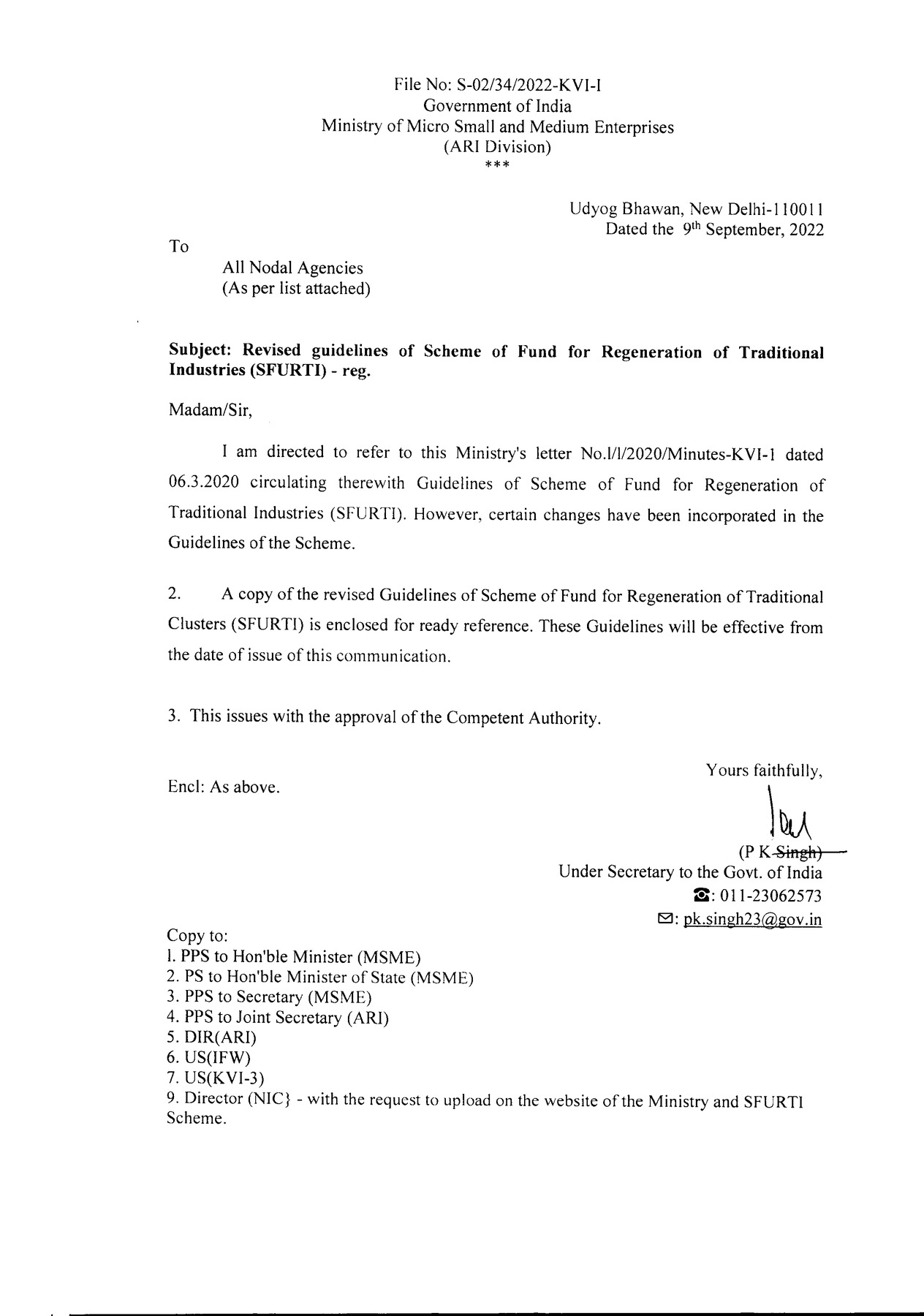
SFURTI Scheme 2026 guidelines are available to download in PDF format from the official website sfurti.msme.gov.in. Scheme of Fund for Regeneration of Traditional Industries (SFURTI) is a central sector scheme of the Ministry of Micro, Small and Medium Enterprises (MSME), Government of India. It organizes traditional industries and artisans into collectives and supports them to make quality and competitive products so that the sector and its artisans stay sustainable for the long term.
This scheme focuses on physical infrastructure creation, technology upgradation, training, product development, innovation, design interventions, marketability, improved packaging and marketing infrastructure. The main aim is to improve the income of artisans and producers working in traditional sectors such as khadi, coir, bamboo, honey, agarbatti, handloom and pottery.
Objectives of SFURTI Scheme 2026
The scheme works through a clear set of objectives that guide how clusters are formed and supported. These objectives are given below.
- Organizing traditional industries and artisans into collectives to make them competitive and provide support for their long-term sustainability and economy of scale.
- Providing sustained employment for traditional industry artisans and producers.
- Improving the marketability of products of such clusters and collectives by supporting new products, design intervention, better packaging and improved marketing infrastructure.
- Equipping traditional artisans and producers of the associated clusters with improved skills and capabilities through training and exposure visits.
- Promoting collective business enterprises of traditional artisans and producers.
- Making provision for common facilities and improved tools and equipment for artisans and producers to promote the best use of infrastructure facilities.
- Setting up multi product clusters with an integrated value chain and a strong market driven approach for viability and long-term sustainability of the cluster.
- Strengthening cluster governance systems with the active participation of the people involved, so that they can understand emerging challenges and opportunities, respond to them in a clear way and make sure the surplus generated by the collective is shared fairly among all artisans and producers.
- Promoting traditional skills, improved technologies, advanced processes, market intelligence and new models of public private partnerships, to gradually copy similar models of collective and cluster based traditional industries.
- Focusing on covering uncovered districts, aspirational districts and similar areas for setting up collectives covering traditional industries, with special focus on endangered art and crafts.
- Supporting traditional artisans with special focus on disadvantaged communities like SCs, STs and women.
- Making sure of convergence from the design stage with each activity of cluster formation and its operations.
- Identifying and understanding the target customers of a collective or cluster, understanding their needs and aspirations, and developing the present product lines to meet the requirements. Big focus should be on the buyer segment that values natural, eco friendly, ethically sourced and unique Khadi and Village Industries products.
- Developing specific product lines out of the currently offered diversified basket of products based on the understanding of the target consumer segment. A brand unification exercise also needs to be done to get the most value.
- Making a big change from a supply driven selling model to a market driven model with the right branding, focus product mix, correct positioning and right pricing to make the offering complete and best for each focus category.
- Using E-Commerce as a major marketing channel and devising a quick strategy to make its presence felt in the E-Retail space.
- Making a big investment in product design and quality improvement, research and development and emerging technologies based on market trends, with an eye to standardize the quality of inputs and processes so that products meet quality benchmarks.
- Promoting the latest technological improvements to take local products to the global market, in line with the call for Atma Nirbhar Bharat.
- Establishing collectives with special focus on adoption of Industry 4.0, Block Chain for traceability, digitization of turnover and artisan income, digitization of training modules, effluent treatment, fire safety, green energy and knowledge repositories.
- Encouraging and promoting green and sustainable products and processes.
Financial Support Under SFURTI Scheme 2026
The government provides financial support to approved clusters based on the number of artisans covered. This support helps set up production facilities, buy modern machinery and run training and marketing activities.
| Detail | Information |
|---|---|
| Scheme Name | Scheme of Fund for Regeneration of Traditional Industries (SFURTI) |
| Launched By | Ministry of Micro, Small and Medium Enterprises (MSME), Government of India |
| Beneficiaries | Traditional industry artisans and producers |
| Support for up to 500 artisans | Up to rupees 2.5 crore |
| Support for more than 500 artisans | Up to rupees 5 crore |
| Soft Interventions | Up to rupees 25 lakh |
| Application Mode | Online through official website |
| Official Website | sfurti.msme.gov.in |
How to Apply for SFURTI Scheme 2026
Eligible agencies such as NGOs, institutions of central and state governments, semi government institutions, Panchayati Raj institutions and private sector bodies forming cluster specific SPVs can apply for the scheme. The application process is given below.
STEP 1 - Go to the official website at sfurti.msme.gov.in and register on the portal with the details of the eligible agency or organization.
STEP 2 - Submit the proposal to the State Office of KVIC. The proposal is scrutinized at the state level and zonal level before it is sent to the Scheme Steering Committee for approval.
STEP 3 - Once the proposal is approved, the cluster is set up with support for production facilities, machinery, raw material, skill development, exposure visits and marketing connect.
Official Guidelines and PDF Download
The revised guidelines of the SFURTI scheme are available as a PDF document. Eligible people and organizations can download the SFURTI revised guidelines PDF to read the full rules of the scheme. More details about the scheme and its benefits are also available on the SFURTI scheme page on the ni-msme website.
Is SFURTI Scheme still running in 2026?
Yes, SFURTI is an ongoing central sector scheme of the Ministry of MSME. It continues to support traditional industry clusters and artisans across the country.
Who can apply for SFURTI Scheme?
NGOs, institutions of central and state governments, semi government institutions, Panchayati Raj institutions and private sector bodies forming cluster specific SPVs with the required expertise to undertake cluster development can apply.
What is the financial support under SFURTI Scheme?
The government provides up to rupees 2.5 crore for clusters with up to 500 artisans and up to rupees 5 crore for clusters with more than 500 artisans. Soft interventions of up to rupees 25 lakh are also supported.