
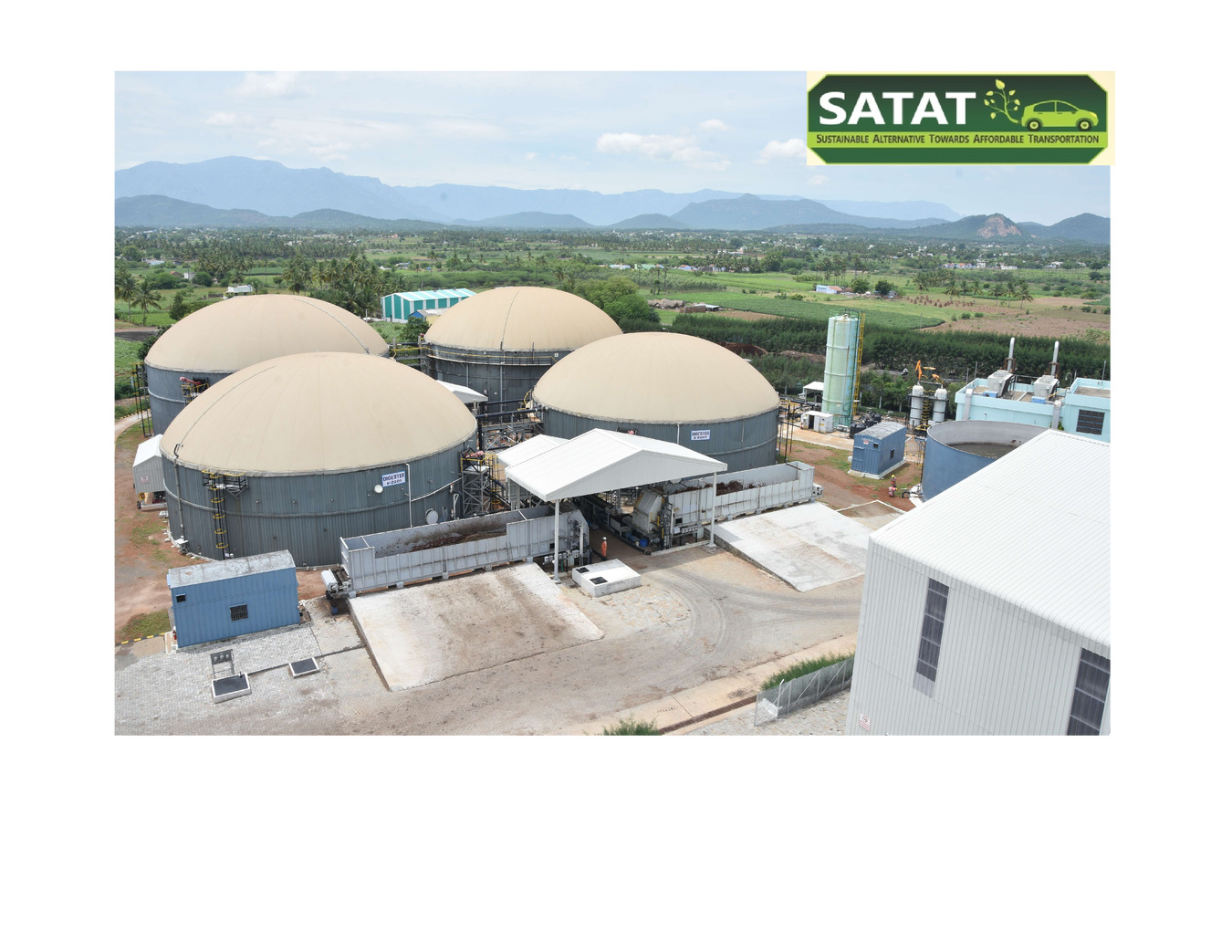
SATAT Scheme 2026 guidelines are available to download in PDF format at official SATAT website. Sustainable Alternative Towards Affordable Transportation (SATAT) is a central government scheme on Compressed Bio Gas (CBG) that encourages entrepreneurs to set up CBG plants and supply the fuel to oil marketing companies for automotive and industrial use.
Ministry of Petroleum and Natural Gas launched SATAT on 1 October 2018. Under the scheme, Expression of Interest (EoI) is invited from possible entrepreneurs to set up Compressed Bio Gas production plants and make biogas available in the market as a transport fuel.
SATAT Scheme 2026
SATAT scheme can boost availability of more affordable transport fuels, improve use of agricultural residue, cattle dung and municipal solid waste, and give farmers an extra source of income. It also helps vehicle users, farmers and entrepreneurs.
As per the latest update, 132 CBG plants have been commissioned under SATAT with a total production capacity of 920 tonnes per day. The scheme was planned to roll out 5,000 CBG plants in phases to produce 15 MMT (million tons) of CBG. The rollout is still going on and the government has added new support measures to speed up plant setup.
CBG is produced from waste and biomass sources like paddy straw, sugarcane press mud, cattle dung, poultry litter and municipal solid waste. After purification and compression, it has high methane content and works like natural gas. It can replace CNG in vehicles and also be used in industries. More details are available on IndianOil's SATAT page.
CBG plants are set up by independent entrepreneurs. The plant owner is responsible for planning, preparation, engineering and execution of the project, including storage of raw material, operation and maintenance of the plant, maintaining final product output quantity and quality, and managing by-products and waste as per existing central and state norms.
How to Apply and Download Guidelines
Entrepreneurs who want to set up a CBG plant can apply through the official SATAT portal and the websites of oil marketing companies. The process starts with downloading the guidelines and submitting an Expression of Interest.
STEP 1 - Go to the official SATAT website at satat.co.in and download the SATAT Scheme guidelines PDF to understand the process, eligibility and technical requirements.
STEP 2 - Check the Expression of Interest (EoI) published by PSU oil marketing companies on their websites, including IndianOil tender portal, BPCL and HPCL.
STEP 3 - Submit the EoI with project details like proposed plant location, feedstock availability, land and production capacity.
STEP 4 - After the EoI is accepted, set up the CBG plant as per the guidelines and sign an agreement with the oil marketing company for sale of CBG.
Benefits of SATAT Scheme
SATAT scheme helps in many ways. It makes transport fuel more affordable, improves waste management and reduces carbon emissions. It also tackles the problem of polluted urban air caused by farm stubble burning.
It boosts entrepreneurship, rural economy and employment, and gives farmers an additional source of revenue. It also helps the country meet its climate change goals, cuts dependence on natural gas and crude oil imports, and acts as a buffer against price fluctuations.
CBG can be integrated with existing networks such as city gas distribution (CGD) networks to boost supplies to domestic and retail users. Besides retailing from OMC fuel stations, CBG can later be injected into CGD pipelines for easy distribution of cleaner and more affordable fuel.
Financial Support under SATAT Scheme
Government support for CBG plants has grown over the years. Ministry of New and Renewable Energy gives Central Financial Assistance (CFA) of ₹4 crore per 4,800 kg of CBG per day, with a maximum of ₹10 crore per project. Reserve Bank of India has put CBG plants in the priority sector for lending, and banks like State Bank of India have come out with specific policies to finance CBG projects.
Market Development Assistance (MDA) of ₹1,500 per MT is given to support marketing of organic fertilizers like Fermented Organic Manure (FOM), Liquid FOM and Phosphate Rich Organic Manures (PROM) produced as by-products from CBG plants. Ministry of Petroleum and Natural Gas has also issued detailed guidelines for procurement of Biomass Aggregation Machinery (BAM) on 2 February 2024.
For easy offtake of CBG, the government introduced the CBG-CGD Synchronisation Scheme (Synchro Scheme) for synchronisation of Biogas and CBG in CGD networks. GAIL has been mandated to run this scheme and supply CBG co-mingled with domestic gas at Uniform Base Price to all CGD entities. A separate scheme for development of pipeline infrastructure (DPI) gives financial support for extending pipeline connectivity from CBG plants to the city gas distribution grid.
CBG plants set up under the umbrella of GOBARdhan Scheme can also get help for selling organic manure by-products through the Market Development Assistance scheme.
Mandatory CBG Blending from 2025-26
National Biofuels Coordination Committee (NBCC) has approved phase-wise mandatory blending of CBG in CNG (Transport) and PNG (Domestic) segments of the CGD sector. The blending obligation started from FY 2025-26. It will be 1% of total CNG and PNG consumption in FY 2025-26, 3% in FY 2026-27, 4% in FY 2027-28 and 5% from FY 2028-29 onwards.
This step will increase the availability of CBG in the country, promote a gas based and circular economy, save foreign exchange and help achieve the net zero emission target.
Highlights of SATAT Scheme
| Detail | Information |
|---|---|
| Scheme Name | SATAT (Sustainable Alternative Towards Affordable Transportation) |
| Launched By | Ministry of Petroleum and Natural Gas |
| Launch Date | 1 October 2018 |
| Eligible People | Entrepreneurs, farmers and CBG plant owners |
| Financial Support | CFA up to ₹10 crore per project |
| CBG Plants Commissioned | 132 plants with 920 tonnes per day capacity |
| Application Mode | Online through EoI on OMC websites |
| Official Website | satat.co.in |
FAQ's
What is SATAT Scheme?
SATAT is a central government scheme on Compressed Bio Gas. It encourages entrepreneurs to set up CBG plants and supply CBG to oil marketing companies for use as automotive and industrial fuel.
Who can apply under SATAT Scheme?
Independent entrepreneurs who want to set up a CBG production plant can apply. They need to submit an Expression of Interest to the oil marketing companies through the official process.
What financial support is available for CBG plants?
Central Financial Assistance of ₹4 crore per 4,800 kg of CBG per day is available, with a maximum of ₹10 crore per project. CBG plants also get priority sector lending from banks and Market Development Assistance of ₹1,500 per MT for organic manure by-products.
Where can I download SATAT Scheme guidelines PDF?
SATAT Scheme guidelines PDF can be downloaded from the official website at satat.co.in.