

 AI Summary
Atmanirbhar Bharat Abhiyan 2026 portal registration and login are available at aatmanirbharbharat.mygov.in. This self reliant India campaign was announced by PM Narendra Modi on 12 May 2020 with an economic package of Rs 20 lakh crore to help the country out of the Coronavirus crisis. The portal now redirects to the MyGov platform where citizens can take part in online activities and share their stories.
Scheme has been closed or it was a one time scheme which has been closed by the government.
Atmanirbhar Bharat Abhiyan aims to make India self reliant and does not support a self centered system. PM Narendra Modi led central government said that in India's self reliance, there is a concern for the whole world's happiness, cooperation and peace. This article explains the complete schemes list for MSMEs, education, health and agriculture sectors.
What is Atmanirbhar Bharat Abhiyan - Complete Details
PM Narendra Modi in his address to the nation on 12 May 2020 announced the Atmanirbhar Bharat Abhiyan. In this Self Reliant India campaign, the central government laid special emphasis on economy growth, local production of goods, strengthening the supply chain and raising demand for products. To make India a self reliant (आत्मनिर्भर) country, the central government announced an economic package of Rs 20 lakh crore to aid the country out of the Coronavirus crisis.
This section covers all the relevant infographics, videos, PDFs and certain policy reform schemes based on the announcements made by the Finance Minister covering the AatmaNirbharBharatAbhiyaan in 5 tranches from 13 May till 17 May 2020. People can also check the schemes list in Atmanirbhar Bharat Abhiyan 3.0 as well as those announced on 12 November 2020.
Atmanirbhar Bharat Abhiyan Portal Registration and Login
Below is the complete procedure to make Atmanirbhar Bharat Abhiyan portal registration and login:-
STEP 1: Firstly visit the Aatma Nirbhar Bharat Abhiyan official website at https://aatmanirbharbharat.mygov.in/
STEP 2: At the homepage, click at the "Register" link present in the main menu to open the Atmanirbhar Bharat Abhiyan portal registration page:-
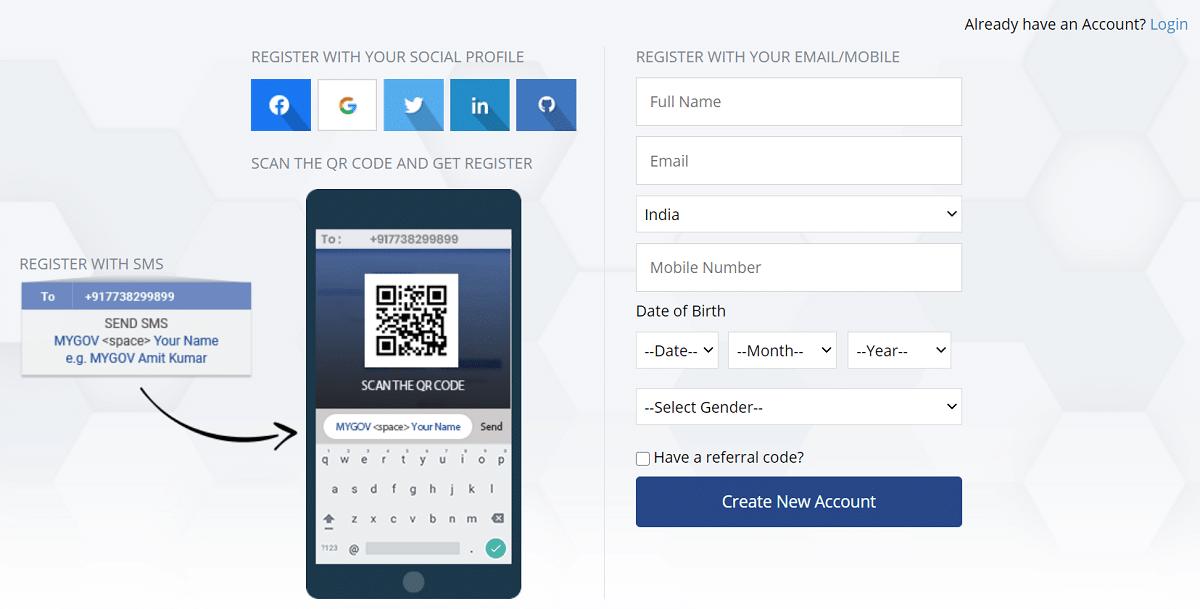
STEP 3: Here candidates can enter their name, e-mail ID, mobile number, date of birth, select gender and then click at "Create New Account" tab. Candidates can even register with their social profile such as through accounts on facebook, google, twitter, linkedin. Moreover, candidates can even send SMS at MYGOV<space>Your Name eg- MYGOV Amit Kumar to +917738299899.
STEP 4: Afterwards, candidates can hit at the "Login" tab present on the Aatmanirbhar Bharat Abhiyan portal homepage to open the page as below:-
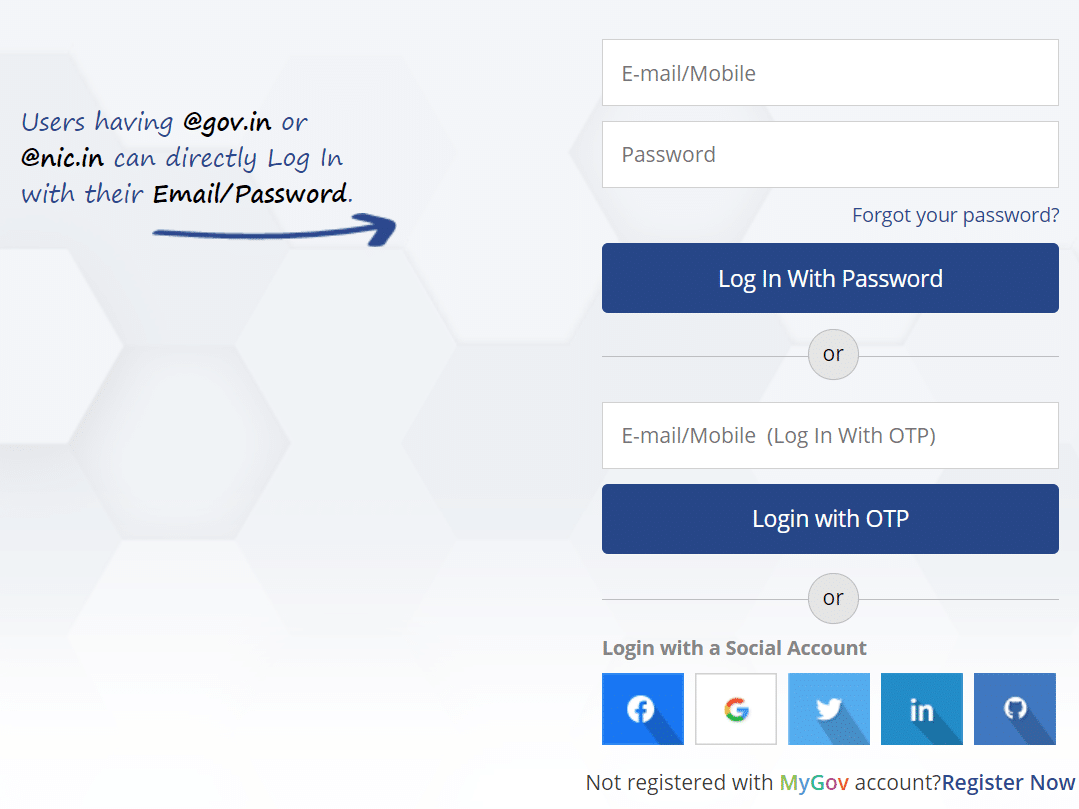
STEP 5: Upon successful registration and login at the Aatmanirbhar Bharat Abhiyan portal, candidates can get involved by taking part in AatmaNirbhar Bharat online activities and can even share their stories.
Atmanirbhar Bharat Abhiyan Highlights
| Detail | Information |
|---|---|
| Scheme Name | Atmanirbhar Bharat Abhiyan |
| Announced By | PM Narendra Modi |
| Announcement Date | 12 May 2020 |
| Package Size | Rs 20 lakh crore |
| Main Sectors | MSMEs, agriculture, health, education |
| Official Website | aatmanirbharbharat.mygov.in |
India's Atmanirbhar Bharat Abhiyan Schemes List
Prime Minister Modi had earlier announced that the central government is providing Rs 20 lakh crore in 2020 (20 lakh crore in 20-20). This Atmanirbhar Bharat Abhiyan package was inclusive of the already announced 1.7 lakh crore PM Garib Kalyan Yojana and 1.7 lakh crore package by the RBI. The main focus of Atmanirbhar Bharat Abhiyan was on making India a manufacturing hub as the country has the youngest workforce. This package was around 10% of the total Gross Domestic Product (GDP) of India.
This economic package of Rs 20 lakh crore under Atmanirbhar Bharat Abhiyan had several features. It was announced in 5 tranche economic doses on 13th, 14th, 15th, 16th and 17th May 2020. Some schemes were announced on 12 November 2020 and the Aatm Nirbhar Bharat Abhiyan 3.0 was announced on 13 November 2020. Now check the details of each of the economic doses.
1st Economic Dose (13 May 2020)
Check out the PM Vision of 20 lakh crore for Businesses including MSMEs. There are 15 different measures to realize the PM Modi's vision of Rs 20 lakh crore. This includes 6 measures for micro, small and medium enterprises (MSMEs), 2 for Employee Provident Fund (EPF), 2 for HFCs / MFIs / NBFCs, 1 for power sector, 1 for real estate, 1 for contractors, 2 as direct tax measures:-
For MSMEs (6 measures)
- 3 lakh crore for MSME Sector - The central government provided collateral free loans to help MSMEs. These loans have 4 years tenure and get a moratorium of 12 months. Around 12 crore workers would be benefited.
- Subordinate Debt based scheme - Rs 20,000 crore for stressed and NPA MSMEs. Around 2 lakh stressed and NPA MSMEs were to benefit.
- Fund of Funds - Rs 50,000 crore of equity infusion into those who have potential and are doing viable business.
- A change in the definition of MSMEs - Investment limit for MSMEs was revised upward and an additional turnover criteria was taken into consideration. Moreover, the difference between manufacturing and service MSME was removed.
- Global Tender to be Disallowed upto Rs 200 cr - Government procurement tenders upto 200 crore were no longer on the global tender group.
- Other Interventions for MSMEs - E-market linkage was provided across the board in absence of trade fairs to promote e-commerce. Within 45 days, CPSEs and Government of India cleared their receivables.
Employee Provident Fund (EPF) (2 Measures)
- Companies having upto 100 employees and 90% having less than 15,000 salary - Liquidity support for all EPF establishments was paid by the central government. This means that the government provided 12% which was to be paid by the employer as well as 12% which was to be paid by the employee. Government of India expanded this contribution for June, July and August 2020. Liquidity relief of Rs 2500 crore EPF support for businesses and workers for 3 months was to benefit 72.22 lakh employees.
- For companies with more number of employees - For the next 3 months, employers and employees had to pay 10% (earlier 12%). For Public Sector Enterprises (PSEs) and Public Sector Undertaking (PSUs), the government paid full employer contribution while government employees paid only 10% for next 3 months. For this purpose, the government provided Rs 6750 crore.
Housing Finance Corporation and Micro Finance and NBFCs (2 Measures)
- Rs 30,000 cr Liquidity Facility for NBFC / HCs / MFIs - Rs 30,000 liquidity investment facility was made in primary and secondary sectors of NBFCs, MFIs and HCs. This was done through taking and buying debt papers of NBFCs, MFIs and HFCs which were fully guaranteed by the Indian government.
- Rs 45,000 cr Partial Credit Guarantee Scheme 2.0 - The central government started Partial Credit Guarantee Scheme 2.0 with an amount of Rs 45,000 crore for NBFC. The first 20% loss was borne by the Government of India.
Power Sector (1 Measure)
- Rs 90k crore Liquidity for DISCOMs - The government provided an Emergency Liquidity Injection of Rs 90,000 crore for DISCOMs.
Contractors (1 Measure)
- Relief to Contractors - All Government of India agencies such as railways and roadways could give upto 6 months extension to contractors to comply with contract conditions. The concessional period was extended for next 6 months. Government agencies partially released bank guarantees on partial completion of projects.
Real Estate (1 Measure)
- Extension of Registration and Completion Date of Real Estate Projects under RERA - The suo moto registration and completion date of all real estate projects under RERA was extended by 6 months. This included even those projects whose expiry date was 25 March 2020.
Tax Measures (3 Measures)
- Rs 50,000 crore Liquidity through TDS / TCS Reduction - From 14 May 2020 to 31 March 2021, TDS / TCS rates were reduced by 25% for all purposes. This gave Rs 50,000 crore liquidity through TDS / TCS reductions.
- Direct Tax Measures - All pending refunds to charitable, professional, partnerships, LLPs, proprietors were given immediately. The due date of all income tax returns was extended to 30 November 2020 and tax receipts to 31 October 2020. The date of assessment getting barred as on 30 September 2020 was extended to 31 December 2020. Those getting barred on 31 March 2021 moved to 31 September 2021. Without any additional amount, Vivad Se Vishwas Scheme was extended to 31 December 2020.
For more details on Atmanirbhar Bharat Abhiyan for Businesses including MSMEs, download the PDF:-
http://164.100.117.97/WriteReadData/userfiles/Aatmanirbhar%20Presentation%20Part-1%20Business%20including%20MSMEs%2013-5-2020.pdf
Economy Booster Dose 2 (14 May 2020)
In this phase, the main focus was on migrant workers, street vendors, small traders, small farmers and self employed persons. There were 9 steps as a part of economy booster dose 2 under Atmanirbhar Bharat Abhiyan. These included 3 for migrant workers, 1 for shishu loan within mudra, 1 for street vendors, 1 for housing, 1 for employment of people in tribal areas and 2 measures related to farmers. The complete details are given here:-
Migrant Workers (3 Measures)
- Free food grains supply to all migrants for next 2 months - All non ration card holders not covered in National Food Security Act (NFSA) or whose name was not in the state ration card list got 5 kg wheat or 5 kg rice per person. In addition, 1 kg chana per family was given. Around 8 crore migrants benefited from this free food supply scheme for non ration card holders with an outlay of Rs 3500 crore.
- One Nation One Ration Card Scheme - To ensure national portability of ration to benefit migrant workers, the central government started the One Nation One Ration Card Scheme. From August 2020, 67 crore migrant workers in 23 states benefited from this scheme which is around 83% of total PDS beneficiaries. 100% beneficiaries coverage under 1 Nation 1 Ration Card Scheme was to be achieved till 31 March 2020.
- Affordable Rental Accommodation for Migrant Labourers and Urban Poor under PMAY - The government started a new rental housing scheme for migrant workers and urban poor under Pradhan Mantri Awas Yojana. In this PMAY rental housing scheme, all migrant workers got houses on lesser rent in the area of their work. This was done by converting government funded houses in major cities into affordable rental housing accommodations or complexes through PPP mode. Moreover, the government provided incentives to business companies, state governments, agencies and associations to provide low rent housing to their workers.
Migrant workers were given 3 meals per day in shelter homes. For urban poor in just last 2 months during the covid period, the central government permitted state governments to use the state disaster management fund to provide shelter, food and water to workers which costs around Rs 11000 crore.
Nearly 12000 SHGs had already produced 3 crore masks and 1.02 lakh litres sanitizers. The central government also provided access to revolving funds to SHGs at the PAiSA portal to raise their capacity building. Around 7200 new SHG groups were formed for urban poor from 15 March 2020.
Shishu Loans under Mudra Yojana (1 Measure)
- Modi government provided interest subvention incentive of 2% on prompt repayment of shishu loans for next 12 months after the moratorium period ended. Around 3 crore beneficiaries were to benefit with this scheme with an outlay of Rs 1500 crore.
Street Vendors (1 Measure)
- Special credit facility of Rs 5000 crore to street vendors was provided by the Indian government. Within 1 month duration, the central government launched a special scheme for street vendors to provide them easy access to credit. Around 50 lakh street vendors were to benefit and most of them got initial working capital of upto Rs 10,000.
Housing (1 Measure)
- The lowest strata of middle income group who earns 6 to 18 lakh per annum, PMAY CLSS scheme which was started in May 2017 and which ended on 31 March 2020 was extended till March 2021. Around 3.3 lakh families had already been benefited till then from the PMAY CLSS scheme. Another 2.5 lakh MIG group people were to benefit from the PMAY CLSS scheme in the next 1 year. This scheme resulted in immediate job creation and raised demand for construction material such as steel, cement and other house construction materials.
Employment Generation for Adivasis (1 Measure)
- Rs 6,000 crore was allocated for employment generation for people in tribal areas (adivasi).
Farmers (2 Measures)
Till date, about 3 crore farmers had availed 63 lakh agricultural loans given to them at concessional rates. Farmers already availed loans worth over Rs 4.22 lakh crore. The interest subvention for prompt repayment of loans was extended from 1 March 2020 to 31 May 2020.
- Rs 30,000 crore additional emergency working capital fund through NABARD - Annually, NABARD provides Rs 90,000 crore for refinance purposes. An additional Rs 30,000 crore additional emergency working capital fund through NABARD (refinance) was released immediately. Around 3 crore small and marginal farmers were to get benefit for their Rabi post harvest work. Rural cooperative banks (state cooperative banks, district cooperative banks) and RRBs got this immediate assistance on tap based lending.
- Around Rs 2 lakh crore concessional credit for KCC - Rs 2 lakh concessional credit was extended for Kisan Credit Card. Around 2.5 crore farmers were to benefit from this KCC scheme. Fisheries and animal husbandry farmers were included in the KCC scheme.
Around 25 lakh new KCC holders were given loans of Rs 25000 crore. Liquidity support of 86,600 crore for farmers was given in the month of March-April. NABARD refinanced 29,500 crore through Rural Cooperative Banks and Regional Rural Banks (RRBs) in March. Around Rs 4200 crore support was provided for rural infrastructure development. State governments also got working capital assistance of Rs 6,700 to procure agricultural produce.
Works in Pipeline for Workers to make India Aatm Nirbhar
Here is the complete list of works which were in pipeline for the government to make India Aatm Nirbhar:-
- Right to minimum wage to all workers.
- National Floor Wage implementation across the country to remove regional difference in minimum wage.
- Appointment letters to workers to make them formal.
- Health benefits for all (at least 1 health checkup).
- New definition for interstate migrant workers to benefit them.
- Portability of welfare benefits for migrant workers.
- Extension of ESIC benefits to all establishments (no restriction of number of employees).
- Mandatory ESIC coverage to all those working in hazardous activities (occupational safety and health).
- Social security benefits extension to all workers.
- Re-skilling of all workers.
- All occupations should be open for women even at nights along with their safety measures.
The central government had already increased the average wage rate of workers from Rs 182 to Rs 202 under MGNREGA. Moreover, the government had already generated 14.62 crore person days of work till 13 May 2020. The annual expenditure was 10,000 crore as work was offered to 2.33 crore workers in 1.87 lakh gram panchayats (40% to 50% more workers enrolled). Furthermore, the central government issued directions to state governments to provide enrollment and provide employment under MGNREGA to workers in their own states.
For more details on 2nd tranche of Atmanirbhar Bharat Abhiyan, please click the link below:-
http://164.100.117.97/WriteReadData/userfiles/Aatma%20Nirbhar%20Bharat%20presentation%20Part-2%2014-5-2020.pdf
3rd Economic Dose (15 May 2020)
This 3rd economic dose of Atmanirbhar Bharat Abhiyan was basically focused on agriculture and allied activities, government and administrative reforms. The first 8 measures were for welfare for fisheries, dairy, animal husbandry, food processing and farmers while the last 3 were government reforms in the system to benefit the agriculture sector.
Agriculture and Allied Activities (8 measures)
The first 8 measures were for agriculture and allied activities which were for strengthening of infrastructure, logistics, capacity and storage for farmers:-
- Farm Based Infrastructure (Rs 1 lakh crore) - The central government allocated Rs 1 lakh crore for aggregators, farmer production organizations (FPOs), primary agriculture cooperative societies and krishi udyami to strengthen farm gate infrastructure. This amount was spent for strengthening of cold chain, post harvest infrastructure, storage centers, yards etc.
- Micro Food enterprises (Rs 10,000 crore) - This scheme was for food enterprises which are micro in size. The central government implemented the Rs 10,000 crore scheme with a cluster based approach to emphasise on vocal for local. Around 2 lakh micro enterprises were to benefit from this marketing and branding scheme. For example, clusters can be made for makhana of Bihar, mango of UP, ragi and coarse grains of Karnataka, kesar of Kashmir, turmeric of Telangana and chillies of Andhra Pradesh. Van sampada clusters were also formed.
- PM Matsya Sampada Yojana (Rs 20,000 crore) - This Rs 20,000 crore for PM Matsya Sampada Yojana included activities related to fisheries and aquaculture. In this scheme, the government provided employment to 55 lakh people. New krishi vessels were given and new krishi harbours were built. Moreover, insurance of persons related to fisheries and their personal boats was done. This resulted in an additional fish production of 17 lakh tonnes. The main aim was to help people by providing them resources. In this scheme, Rs 11000 crore was given for aquaculture and 9000 crore for vessels and harbours.
- FMD Livestock Disease Control Scheme (Rs 13,000 cr) - To eliminate foot and mouth disease, 100% vaccination of cattle, buffaloes, sheep and goat was done. India has 53 crore livestock which is the largest in the world. From January 2020, around 1.5 crore cows and buffaloes were vaccinated. In green zones, vaccination was started soon. To achieve 100% vaccination of livestock, the government spent Rs 13,343 crore.
- Animal Husbandry Infrastructure Development Fund (Rs 15000 crore) - The central government spent Rs 15k crore for dairy infrastructure development fund. In this scheme, private investment was allowed. The government provided incentives for exporting of milk, cheese, ghee and to produce cattle feed.
- Promotion of herbal cultivation (Rs 4000 crore) - Upto 10 lakh hectares (25 lakh acres) of land was to be used for herbal cultivation. This scheme resulted in an additional Rs 5000 crore of income for farmers. On both the banks of Ganga, herbal plants can be grown. Around 800 hectares of area of Ganga corridor was given for cultivation of herbal and medicinal plants.
- Promotion of Bee keeping (Rs 500 crore) - The central government spent Rs 500 crore on bee-keeping schemes to benefit 2 lakh beekeepers. This ensured better standards of living for beekeepers and people got better honey. Moreover, wax for medicinal and other purposes was imported till then, so honeybee keeping helped in meeting the wax requirement of India locally and there is potential to become its exporter.
- Operation Greens (additional Rs 500 crore) - The government had already launched Operation Green to take care of onion, tomato and potato (OTP) crops. Now farmers producing these perishable items got 50% subvention on transportation and 50% on storage. This scheme was extended and expanded for other perishable food items such as fruits and vegetables with an additional amount of Rs 500 crore.
Government and Administrative Reforms (3 measures)
- Amendment in Essential Commodities Act 1955 - This Essential Commodities Act came into force in FY 1955 to reduce food shortage. Now as India is producing food items in abundance, the government amended the Essential Commodities Act 1955. From then onward, cereals, oilseeds, onion, potato, pulses and edible oils were deregulated. No stock limit shall apply for food processors subject to installed capacities. However, there are certain provisions in which the government can take steps on these crops in case of price hike or natural calamities.
- Central law for farmers to sell their produce at attractive prices - The government framed a central law in which farmers got the leverage to sell their agricultural produce at attractive prices. There would be no barriers in interstate selling of agricultural products and e-trade was also allowed for farmers.
- Facilitative legal framework - A new standardized mechanism was framed in collaboration with large retailers, exporters, aggregators and farmers to ascertain them with the price of sowing and selling and other information at the start of each season.
Support System Established for Farmers during COVID-19 lockdown
In India, around 85% of the operational landholdings are with small and marginal farmers. Farmers work in adverse conditions, endured a lot and made India reach global level. India is the largest producer of milk, jute and pulp, second largest in production of sugarcane, cotton, fruits and vegetables and third largest in production of cereals. In the past 2 months, take a look at the support system established during the COVID-19 lockdown. The central government performed MSP purchase to an extent of Rs 74,300 crore. In addition, Rs 18,700 was transferred to accounts under PM Kisan Samman Nidhi Yojana.
The claim payment of Rs 6,400 crore under Pradhan Mantri Fasal Bima Yojana was cleared. Around 560 lakh litres of milk per day was procured by the government. In total 111 crore litre of milk was procured and for this purpose, the government paid Rs 4100 crore to dairy cooperative farmers. Furthermore, the government provided an interest subvention of 2% for dairy cooperatives and an additional 2% on prompt repayment. This resulted in Rs 5000 crore additional liquidity for farmers and benefited around 2 crore farmers.
For more details on 3rd tranche of Atmanirbhar Bharat Abhiyan Package, click the link below:-
http://164.100.117.97/WriteReadData/userfiles/Aatma%20Nirbhar%20Bharat%20Presentation%20Part-3%20Agriculture%2015-5-2020%20revised.pdf
4th Economic Dose (16 May 2020)
In the 4th tranche of Atmanirbhar Bharat Abhiyan, the central government focused on structural reforms in 8 sectors. These are Coal, Minerals mining, Defense production, Civil Aviation (airspace management, PPP and airports, MRO Hubs), Power distribution sector, Social Infrastructure Projects, Space and Atomic energy sectors. Now let us study the structural reforms made in each of these sectors.
Coal Sector
- Earlier coal was a product with monopoly of the central government but to promote commercial mining in the coal sector, government monopoly was removed. It led to more coal availability at market prices and liberalized entities were allowed to participate.
- India has the 3rd largest valued coal in uncapped mines and still imports coal. So regulations are required. Now the government provided incentives on coal gasification to prevent environment and coal extraction beds were auctioned. The government spent Rs 50,000 crore for creating evacuation infrastructure.
Mineral Mining Sector
- A seamless composite exploration cum mining cum production mechanism was set up. Around 500 new mining blocks were auctioned.
- The central government removed the difference between captive and non-captive mining.
- In addition, the government is in the process of development of a mineral index.
- Rationalization of stamp duty was done while providing mining leases.
Defence Sector
- The government notified a list of weapons which are not allowed to import. Every year the list will be increased.
- The central government focused on indigenisation of imported spares. A separate budget provision was made for domestic capital procurement.
- The 3rd step was to provide autonomy and accountability to ordinance factories. Corporatization (not privatization) of the ordinance factories board was done.
- Foreign Direct Investment (FDI) limits were raised from 49% to 74%. The central government also gave priority to time bound defence procurement.
Civil Aviation (Airspace management, PPP and airports, MRO Hub)
- For airspace management, around 60% of airspace was only available for civil flights due to military restrictions. So the government focused on optimum use of airspace. This saved fuel, reduced ticket prices and reduced travel time and saved around Rs 1000 crore.
- For PPP and airports, 6 more airports were brought in by the central government for auction. Airport Authority of India (AAI) did this on PPP basis. The government sought additional investment to provide high quality facilities at airports. The government had already received Rs 13,000 crore investment in 1st and 2nd round of 12 airports. Now with these 6 airports, more investment was expected to come.
- Maintenance, Repair and Overall (MRO) Hubs were set up in India to perform maintenance, repair, service and other works related to civil aeroplanes and defence aircrafts.
Power Sector
- Power distribution companies in all Union Territories were privatized in line with tariff policy. Moreover, private players got open access as well as incentives on timely payments. This made sure power distribution is sustainable.
- The DISCOMs made sure adequate power and less load shedding to provide adequate power supply to consumers. For consumers, smart prepaid meters were installed while DBT process was started for electricity bills directly in bank accounts of consumers.
Social Infrastructure Project Sector
- To enable setting up of more schools, hospitals and other social infrastructure projects, the government started providing increased Viability Gap Funding (VGF) for private players with an outlay of Rs 8100 crore. This raised VGF boosted private investment in health and education sector.
Space Sector
- Private sector got access to ISRO assets. The central government brought a predictable policy for private players to get access to the space area.
- The government provided a level playing field for private companies which means that private companies can now participate in planetary exploration, outer space exploration, launching satellites and other space activities.
- Moreover, the government provided access to remote sensing data to private startups.
Atomic Energy Sector
- Research reactor was established in public private partnership (PPP) mode for production of medical isotopes for cancer.
- The government also focused on establishing facilities in PPP mode to use irradiation technology to prevent perishable crops from getting rotten.
- In addition, the central government set up various Technology cum Incubation Centres.
Reforms made by Modi Government from 2014-2020
The following are the reforms which were made by the Modi led Indian government in past 6 years:-
1) Direct Benefit Transfer (DBT)
2) Goods and Services Tax (GST)
3) Insolvency Bankruptcy Code (IBC)
4) Starting of UPI platforms
5) Ease of Doing Business Reforms
6) Public Sector Bank reforms
7) Direct Taxation reforms
8) Power sector reforms
9) Coal sector reforms
10) Empowered group of Secretaries Constituted
11) Budget development cell to be constituted
Various policy reforms had been made by the central government to fast track investment such as ranking of states on investment attraction and promotion of champion sectors such as solar PV and advance battery manufacturing cells among others. The Make In India scheme was launched to promote local production of goods. The government also focused on upgradation of industrial infrastructure. 3376 industrial parks which are set up in 5 lakh hectares would now be mapped. The government made the process of providing land passes to industries easier as all industrial parks would be mapped. The issue of connectivity would be resolved and common infrastructure development would be improved.
For more details on 4th tranche of Atmanirbhar Bharat Abhiyan Package, click the link below:-
http://164.100.117.97/WriteReadData/userfiles/AatmaNirbhar%20Bharat%20Full%20Presentation%20Part%204%2016-5-2020.pdf
5th Economic Dose (17 May 2020)
FM Nirmala Sitharaman announced the 5th economic dose under Atmanirbhar Bharat Abhiyan on 17 May 2020. Check out the complete details here:-
Health Related Steps for COVID-19
Till date, the government has announced various health related steps of around Rs 15,000 crore for COVID-19 containment.
- Already announced (Rs 15,000 crore) - Out of this 15k crore, around 4113 crore have been released to states, essential items have been purchased worth Rs 3750 crore, testing kits worth Rs 550 crore. Moreover, the government provided insurance cover of Rs 50 lakh per person for health professionals under the flagship Pradhan Mantri Garib Kalyan Yojana.
- Use of Information Technology - In order to use IT, the government rolled out e-Sanjeevani Tele Consultation Services. To make sure capacity building, the iGOT platform was launched. Moreover, the Aarogya Setu App and Aarogya Setu Mitr website were also launched to prevent Indian citizens from Coronavirus.
- Protection to Health Workers - The central government made an amendment in the Epidemic Diseases Act and adequate provisions for PPEs. There are now more than 300 domestic manufacturers (from 0 earlier). The government has already supplied 51 lakh PPEs, 87 lakh N95 masks and 11.08 crore HCQ tablets.
Health Reforms and Initiatives
Now there would be increased investments in the public health sector and public expenditure on health would be increased.
- There would be more investments in grass root health institutions and the government will ramp up health and wellness centres in rural and urban areas.
- To prepare India for any future pandemics, the government set up Infectious Diseases Hospital Blocks in all districts.
- Lab network and surveillance would be strengthened. There would be Integrated Public Health Labs in all districts and block level Labs and Public Health Unit to manage pandemics.
- Moreover, the government encouraged research by creating a National Institutional Platform for One Health by ICMR.
- The central government started implementation of the National Digital Health Blueprint under the National Digital Health Mission.
Online Education for Students during COVID-19
Here is the list of various technology driven systems for online education during the Coronavirus (COVID-19) lockdown:-
- 12 More SWAYAM PRABHA DTH channels - In order to support and reach those who do not have access to the internet, the government started 3 SWAYAM PRABHA DTH channels for school education. Now another 12 SWAYAM PRABHA DTH channels (1 for each class) were added.
- The government made provision for telecast of live interactive sessions on these channels with experts from home through Skype.
- The government also tied up with private DTH operators like Tata Sky and Airtel to air educational video content to enhance the reach of these channels. The central government coordinated with states of India to share air time (4 hrs daily) on the SWAYAM PRABHA channels to telecast their education related contents.
- Till date, the DIKSHA platform has had 61 crore hits from 24 March 2020 till date. More 200 new textbooks were added to e-Paathshaala.
PM eVIDYA / DIKSHA / Manodarpan Initiatives for Education Post COVID-19
After COVID-19, the government focused on technology driven education with equity. For this purpose, the following measures were announced:-
- PM eVIDYA - A programme for multi-mode access to digital/online education was launched immediately. This PM E-Vidya scheme comprised of the following measures:-
- One Nation One Digital Platform - DIKSHA for school education in states/UTs. E-content and QR coded Energized Textbooks for all grades.
- One Class One Channel - One earmarked TV channel per class from 1 to 12.
- Extensive use of Radio, Community radio and Podcasts.
- Special e-content for visually and hearing impaired.
- Top 100 universities were permitted to automatically start online courses by 30th May, 2020.
- Manodarpan - An initiative for psychosocial support of students, teachers and families for mental health and emotional well-being was launched immediately.
- New National Curriculum and Pedagogical framework for school, early childhood and teachers was launched. This was integrated with global and 21st century skill requirements.
- National Foundational Literacy and Numeracy Mission for making sure that every child attains learning levels and outcomes in grade 5 by 2025 was launched by December 2020.
Reforming Governance for Ease of Doing Business
Globally, all the potential investors look at a country's Doing Business Report (DBR) ranking. To improve DBR ratings of India, the government has taken various measures:-
- The government has taken sustainable measures which have resulted in steadily improving India's position in World Bank's DBR rank from 142 in 2014 to 63 in 2019.
- To get a better DBR rating, the government streamlined processes such as granting of permits and clearance, self-certification and third party certification etc.
- The government is working on a mission mode on the next phase of Ease of Doing Business Reforms. These include measures relating to easy registration of property, fast disposal of commercial disputes and a simpler tax regime for making India one of the easiest places to do business.
Recent Corporate Law measures for Ease of Doing Business
The following Corporate Law measures were taken to boost Ease of Doing Business:-
- Decriminalization of Company Law Defaults 2018 (1st Phase) - In the first phase of decriminalization of Company Law defaults in 2018, 16 compoundable offences were shifted to an in-house adjudication and penalty mechanism.
- Integrated Web based Incorporation Form - A new and simplified proforma for Incorporating Company Electronically Plus (SPICe+) was introduced which extends 10 services of different Ministries and one State Government through a single form.
- Databank of Independent Directors launched.
- Withdrawal of more than 14,000 prosecutions under the Companies Act, 2013.
- Rationalization of Related Party Transaction related provisions.
- Timely action during COVID-19 to reduce compliance burden under various provisions of the Companies Act 2013 as well as enable companies to conduct Board Meetings, EGMs and AGMs, and Rights issue by using the strengths of Digital India.
- In 221 resolved cases, 44% recovery has been achieved since the inception of IBC, 2016. This includes admitted claims amount to Rs 4.13 lakh crore while the realizable amount is Rs 1.84 lakh crore. Under IBC, 13,566 cases involving a total amount of Rs 5.01 lakh crore (approx.) have been withdrawn before admission under provisions of IBC till 29th Feb 2020.
Rs 40,000 Cr Increase in MGNREGA Allocation for Employment Boost
The central government allocated an additional amount of Rs 40,000 crore under the MGNREGS scheme:-
- This helped in generating nearly 300 crore person days in total under Mahatma Gandhi National Rural Employment Guarantee Act.
- The government addressed the need for more work including returning migrant workers in the Monsoon season as well.
- Creation of larger number of durable and livelihood assets including water conservation assets to boost the rural economy through higher production.
Decriminalisation of Companies Act Defaults
Decriminalization of Companies Act violations involving minor technical and procedural defaults (shortcomings in CSR reporting, inadequacies in board report, filing defaults, delay in holding AGM). The following measures were also taken:-
- Majority of the compoundable offences sections were shifted to internal adjudication mechanism (IAM) and powers of RD for compounding were enhanced (58 sections to be dealt with under IAM as compared to 18 earlier).
- The amendments de-clogged the criminal courts and NCLT.
- 7 compoundable offences altogether dropped and 5 to be dealt with under an alternative framework.
Other measures include Ease of Doing Business for Corporates, Public Sector Enterprise Policy for a New and Self-reliant India, Supporting State Governments and promoting state level reforms and further enhancement of Ease of Doing business through IBC related measures. For more details on 5th tranche of Atmanirbhar Bharat Abhiyan Package, click the link below:-
http://164.100.117.97/WriteReadData/userfiles/Aatma%20Nirbhar%20Bharat%20%20Presentation%20Part%205%2017-5-2020.pdf
Atmanirbhar Bharat Abhiyan 3.0 (Update As on 13 November 2020)
Finance Minister Nirmala Sitharaman announced new measures in the series of stimulus announcements the government has been making since the onset of the coronavirus crisis in the country. While addressing the press briefing, Sitharaman said that the country is showing good signs of a strong recovery from the downtrend in the economy. Atmanirbhar Bharat Abhiyan 3.0, which is the 3rd tranche under the Aatm Nirbhar Bharat Economic Package, was launched. The size of the stimulus being provided by the government, as part of the 12 announcements made under Aatmanirbhar Bharat 3.0, amounts to Rs 2.65 lakh crore. This equals 15% of national GDP as stimulus takeaway whose important points are as follows:-
- Rs 900 crore provided for COVID Suraksha Mission for research and development of the Indian COVID vaccine to the Department of Biotechnology.
- Rs 3,000 crore will be released to EXIM Bank for promotion of project exports through Lines of Credit under the IDEAS scheme. Supported projects cover railways, power, transmission, road and transport, auto and auto components, sugar projects etc.
- An additional outlay of Rs 10,000 crore was provided for PM Garib Kalyan Rozgar Yojana in the current financial year, to boost rural employment.
- 10 new Champion sectors were covered under the Production Linked Incentives scheme to boost the competitiveness of domestic manufacturing. It is expected to give a significant boost to economic growth and domestic employment.
- The central government launched a credit guarantee support scheme for the healthcare sector and 26 sectors stressed due to COVID19. Entities got additional credit up to 20% of outstanding credit, repayment can be done in five years' time (1-year moratorium + 4 years repayment).
- If new employees of a requisite number were recruited from October 1, 2020 to June 30, 2021, the establishments were covered for the next two years.
- The existing Emergency Credit Line Guarantee Scheme was extended till 31st March 2021.
- Aatmanirbhar Bharat Rozgar Yojana was launched to incentivise the creation of new employment opportunities during COVID19 recovery.
- Every EPFO registered organisation, if they take in new employees or those who had lost jobs between March 1 and September 30, these employees got benefits.
- Atmanirbhar Bharat Rozgar Yojana was introduced as a new stimulus measure to create new employment opportunities in the country during COVID recovery phase.
- SBI Utsav cards being distributed under the festival advance scheme announced on 12th Oct. 11 states sanctioned Rs 3,621 crore as an interest-free loan towards capital expenditure.
- Under the Emergency Credit Liquidity Guarantee Scheme, a total amount of Rs 2.05 lakh crore was sanctioned to 61 lakh borrowers, out of which Rs 1.52 lakh crore was disbursed.
Markets are on a record-high and India's foreign exchange reserves are at USD 560 billion. India has made a strong comeback economically. RBI has said that India will do better in Q4. So the mood in the country, as well as Moody's rating for India, has improved.
Beneficiaries of Aatmanirbhar Bharat Abhiyan
The following are the major beneficiaries of Aatmanirbhar Bharat Abhiyan:-
- Shramik (Labourers / Workers)
- Kisan (Farmers)
- Daily Wage Earners
- People who work for the development of the country
- Middle class people who pay income tax to the government
- Upper class people who give strength to the economy
5 Pillars of Growth under Aatma Nirbhar Bharat Abhiyan
There are 5 basic pillars for the growth of the Aatma Nirbhar Bharat Abhiyan:-
1) Economy (Quantum Jump in Economy)
2) Infrastructure
3) Our System (21st century Technology Driven System)
4) Demography
5) Demand and Supply Chain
Sectors to Benefit from Aatmanirbhar Bharat Abhiyan
The following sectors would be immensely benefited from the Aatm Nirbhar Bharat Abhiyan:-
- Primary Sector: Agriculture Sector, Mining Sector, Fishing Sector.
- Secondary Sector: Construction Sector, Manufacturing and Utilities, MSME (Micro, Small and Medium Enterprises), Cottage Industries etc.
- Service / Tertiary Sector: Retail, Tourism, Banking, Real Estate, Entertainment, Communication, Hospitality and leisure, IT services etc.
- Quaternary Sector: Public sector, Education, Research and development.
4 L Factors of Self Reliant India Campaign
Here are the key factors which were kept in mind to make the 21st century of India. The main focus will be on the following four key factors (4 L's):-
- Land
- Labour
- Liquidity
- Laws
The global value chain integration would be done to turn local brands into global brands.
Govt. Initiatives in Past 6 years for Aatm Nirbhar Bharat
The central government had already taken various schemes to make India self reliant in the past 7 years which are as follows:-
- Poor People - Various schemes like Swachh Bharat Abhiyan, Ayushman Bharat Yojana, DBT based reforms, Jan Dhan Accounts, Micro insurance schemes, PM Awas Yojana, PM Ujjwala Yojana.
- Farmers - PM Fasal Bima Yojana, PM-Kisan Yojana, Creating new Fisheries department, PM Krishi Sinchai Yojana.
- Businesses - Public sector bank recapitalization, PSB merging, FDI, Ease of business reforms, GST reforms.
- National Reforms - Airport privatization, Power sector reforms, 175 GW of Solar targets, Cleaning up of mining sector.
Total Allocation for Atmanirbhar Bharat Abhiyan
Here is the total allocation of money under the flagship Atmanirbhar Bharat Abhiyan:-
| Description | Cost in Crores |
|---|---|
| Reserve Bank of India (RBI) Measures | 8,01,603 |
| Tax Concessions from 22 March 2020 | 7,800 |
| Pradhan Mantri Garib Kalyan Yojana | 1,70,000 |
| PM Modi's Announcement for Health Sector | 15,000 |
| Emergency W/C facility for businesses including MSMEs | 3,00,000 |
| Subordinate debt for stressed MSMEs | 20,000 |
| Fund of Funds for MSMEs | 50,000 |
| EPF Support for Business and Workers | 2,800 |
| Reduction in EPF Rates | 6,750 |
| Special Liquidity Scheme for NBFC / HFC / MFI | 30,000 |
| Partial Credit Guarantee Scheme 2.0 for liabilities of NBFCs / MFIs | 45,000 |
| Liquidity Injection for DISCOMs | 90,000 |
| Reduction in TDS / TCS Rates | 50,000 |
| Free food grain supply to stranded migrant workers for 2 months | 3,500 |
| Interest subvention for MUDRA Shishu loans | 1,500 |
| Special credit facility to street vendors | 5,000 |
| Housing CLSS-MIG | 70,000 |
| Additional Emergency Working Capital through NABARD | 30,000 |
| Additional Credit through KCC | 2,00,000 |
| Food Micro Enterprises | 10,000 |
| Pradhan Mantri Matsya Sampada Yojana | 20,000 |
| TOP to Total: Operation Greens | 500 |
| Agri Infrastructure Fund | 1,00,000 |
| Animal Husbandry Infrastructure Development Fund | 15,000 |
| Promotion of herbal cultivation | 4,000 |
| Beekeeping Initiative | 500 |
| Viability Gap Funding | 8,100 |
| Additional MGNREGS Allocation | 40,000 |
| Total Allocation | 20,97,053 |
FAQ's
What is Aatma Nirbhar Bharat Abhiyan?
Aatma Nirbhar Bharat Abhiyan or Self Reliant India campaign is a new scheme of the Modi led Union government of India to make India self dependent. The main aim is to make India a manufacturing hub which is able to meet its own requirements and produce for others also. In simple words, India must become a major exporter of goods and services rather than an importer of things.
What are the main factors to be considered?
In this scheme, the government focused on economy growth, infrastructure development, improvement in system, demography and demand-supply chain.
What is the assistance amount provided by the Modi government?
For this Aatmanirbhar Bharat Abhiyan, the Indian government provided assistance of Rs 20 lakh crore for various sectors. This amount is around 10% of the total India's GDP.
What is the need to start this Self Reliant India Campaign?
As the coronavirus pandemic crisis was ongoing, the world's economy including India was on a slowdown and witnessed a great downfall. Major countries across the world were in lockdown to tackle COVID-19 spread. The Indian government also imposed a nation-wide lockdown in which all the industries, factories and shops were closed and the economy was on a downfall. So to revive the Indian economy amid the COVID-19 crisis, the government decided to provide assistance under the Self Reliant India campaign.
Is there any particular sector to benefit the most?
All the sectors as mentioned above would be benefited so that the entire Indian economy could get a boost. The main focus would be on improvement in land issues, labour, liquidity support and laws. This Atmanirbhar Bharat campaign put India's economy back on track and also lessened the risk of job loss.
Who are the major beneficiaries of Aatma Nirbhar Bharat Abhiyan?
The farmers, labourers, construction workers, middle class people, public sector workers, upper class people and all those who work hard for the growth of the economy would be the major beneficiaries.
For more details, please visit the official website of the Ministry of Health and Family Welfare at https://mohfw.gov.in/
we also
My name is Randhir Kumar choudhary I am event Photoghepar how benefit my business to do this facility get
अभी इतनी डिटेल्स आई नहीं हैं जैसे ही इस अभियान की डिटेल्स आती हैं, हम इस पेज पर अपडेट करते रहेंगे
Main ek motor line ka worker hu mujhe iska labh kaise milega.
इसका लाभ प्रत्यक्ष और अप्रत्यक्ष रूप से सभी को मिलेगा
How can we apply for atmanirbhar loan for online because I can not found the online form please help me for this
There is no form as of yet
My name is bhavesh and I am barber can I get the loan
Yes, everyone subject to the eligibility and document requirement can take the loan
Rachna Sarovar
I am new to your audience and hit this article as my first visit, I would say you are doing fantastic work, and of course, this would be super useful.
Thank You
Widow yojana in covid Maharashtra
Good Sir
HOW IT IS GOOD, DID YOU GET THE MONEY TO REESTABLISHMENT OF YOUR BUSINESS, PLEASE CONFIRM ME ON 880883239.
OR ITS JUST FOR CHATUKARITA PURPOSE.
I am not getting befits of Govt. scheme.
whenever I am trying but it doesn't work
where exactly should I apply for loan.
Main Ek restaurant sanchalak hun mujhe Se Kya Labh mil sakta hai
aap aone restaurant ke vistaar ke liye loan le sakte hein, MUDRA yojana ke tahat
Randheer kumar yadav
Chhattisgarh main ham log railway hai
detailing about construction labour
detailing about construction labour, what provision made by govt of india for construction labours
Labourer to get free ration for next 2 months, loan scheme would be there very soon.
me State Bank of India, Branch code 10637, Rajasthan High Court Jaipur me loan ke liya gaya. Me typist Hoon, mujhe laptop, scanner and Zerox machine ke liya loan chahiye tha. Bank ke employee Mr. khan ne yaha kahakar mana kar diya ki loan sirf sarkari nokri walo ko milta he. Now what can I do.
Nahi aisa kuch nahi hai, aap MUDRA Loan ke baare m pata kijiye... You can also apply online, details here http://sarkariyojana.com/pradhan-mantri-mudra-yojana/
can i take atam nirbhar loan , i m running confectionery shop
Gram seoni tola post mohgaon kachi teshll Lakhnadon jila seoni madhyprdeshKanahiya
hello main ek computer centre ka owner hu mujhe kis suvidha ke tahat labh mil sakta hai
Aap MUDRA Loan ke tahat apne business ke vistaar ke liye loan le sakte hain
Maine agarbatti company ke liya ek baar loan liya hai, aur one year ho chuka hai kya mai dubra le sakta hu. Mujhe loan ki bahut jarurat hai
Touch with me always
i apply for lone
I am khalid iam kerela kannur i have small scle bussiness improve bussnss forr fund pleas hlp me my mob no .919526943750
need to know about death due to covid
,what is the compensation given by company .
How to apply for aatma nirbhar loan
I want to start new setups.
Proposal: production of recombinant antigen and monoclonel antibody.
Scope: active pharmaceuticals ingredients of diagnostic industry.
Tha same platform for vaccination.
Investment: 4 to 6 crore
Competitor: 4 companies in foreign countries.
Import: more than 100cr per year.
Each product require 3 molecules to manufacture one product and there are hundreds of products belong to this category. Same platform is involved. So ,no risk involved
I WANT A LOAN TO BUILD A FARM FOR FARMING, WHAT NEEDS TO BE DONE FOR THAT
i will started my new business fish aquaculture. so i need this lone scheme.
how to try for his lone scheme
can we apply for atmanirbhar loan for online because I can not found the online form please help me for this