

 AI Summary
Doodh Sanjeevani Yojana (DSY) 2026 is a nutrition scheme of the Gujarat government that helps tackle malnourishment by providing fortified milk to children, pregnant women and lactating mothers in tribal areas. The scheme was first implemented in 2006-07 and later launched on a pilot basis in six tribal districts on 24 December 2009 by the then Chief Minister and now Prime Minister Narendra Modi. In 2026, the state government has expanded the scheme to cover all tribal ICDS blocks across Gujarat.
This article explains the complete details of the Doodh Sanjeevani Yojana in Gujarat, including the latest 2026 updates, budget allocation, eligibility, benefits and official links.
Doodh Sanjivani Yojana in Gujarat Budget 2026-27
Finance Minister Kanubhai Desai presented the Gujarat Budget 2026-27 on 18 February 2026. The state has allocated Rs 7,690 crore to the Women and Child Development sector, with a focus on nutrition, anganwadi infrastructure and technology-based monitoring.
For the Doodh Sanjeevani Yojana, the government has allocated Rs 38.64 crore to increase the fat content in milk provided under the scheme from 1.5 per cent to 3 per cent. As a pilot project in Narmada, Dahod and Dang, the fat content will be raised to 4.5 per cent. The scheme has also been expanded to 53 more tribal components.
Gujarat Doodh Sanjeevani Yojana 2026
Doodh Sanjeevani Yojana aims to improve and enrich the level of nutrition of primary school going tribal students and other beneficiaries in tribal areas. The scheme is fully funded by the state government.
Latest Update: Expansion to All Tribal ICDS Blocks
On 17 July 2026, the Women and Child Development Department issued a resolution approving the expansion of the Doodh Sanjeevani Yojana to the remaining 53 ICDS blocks in tribal districts. With this, the scheme now covers all ICDS blocks in the state's tribal areas. The department has also approved a pilot project to provide high-fat fortified milk to scheme beneficiaries.
Before this expansion, the scheme was being implemented across 20 districts, including the major tribal districts of Banaskantha, Sabarkantha, Aravalli, Mahisagar, Panchmahal, Dahod, Chhota Udepur, Narmada, Bharuch, Surat, Tapi, Navsari, Valsad and Dang, along with selected developing areas of Kutch, Devbhoomi Dwarka, Patan, Kheda, Jamnagar and Botad.
Inception of Doodh Sanjeevani Yojana
The scheme was first implemented in 2006-07 for 48,109 tribal students in 299 primary schools and 26 Ashram schools of Danta and Amirgadh Talukas in Banaskantha district. It was later launched on a pilot basis in six tribal districts on 24 December 2009 by the then Chief Minister and now Prime Minister Narendra Modi.
Within five years, the scheme grew from 6 to 20 districts. In 2014, it was extended to 106 ICDS components across 14 additional tribal districts and 20 developing talukas. From 2016, the cooperative dairy sector was integrated into the scheme, with the production and supply of fortified milk undertaken by leading cooperative dairies, including Banas, Amul, Sumul and Maahi.
Partner and Geographical Footprints
District level cooperative dairies are the partners in the Doodh Sanjeevani Scheme. The scheme finds its geographical footprints in tribal talukas and developing areas across the state.
Eligibility Criteria and Intended Beneficiaries
Schedule Tribe (ST) students of primary schools and Ashramshalas are the intended beneficiaries of the Doodh Sanjeevani Yojana. In the expanded form, children, pregnant women and lactating mothers attending anganwadis in tribal areas also get the benefit of fortified milk.
Benefits under Dudh Sanjivani Yojana
Beneficiaries get 200 ml of fortified flavoured milk every day. Earlier, the milk was provided with 1.5 per cent fat. Under the new pilot, 3 per cent fat milk will be provided in Narmada, Dahod and Dang, while 4.5 per cent fat milk will be provided in Valsad and Sabarkantha. Higher fat content is expected to better support children's physical development and nutritional needs.
Key Achievements of Dudh Sanjivani Scheme
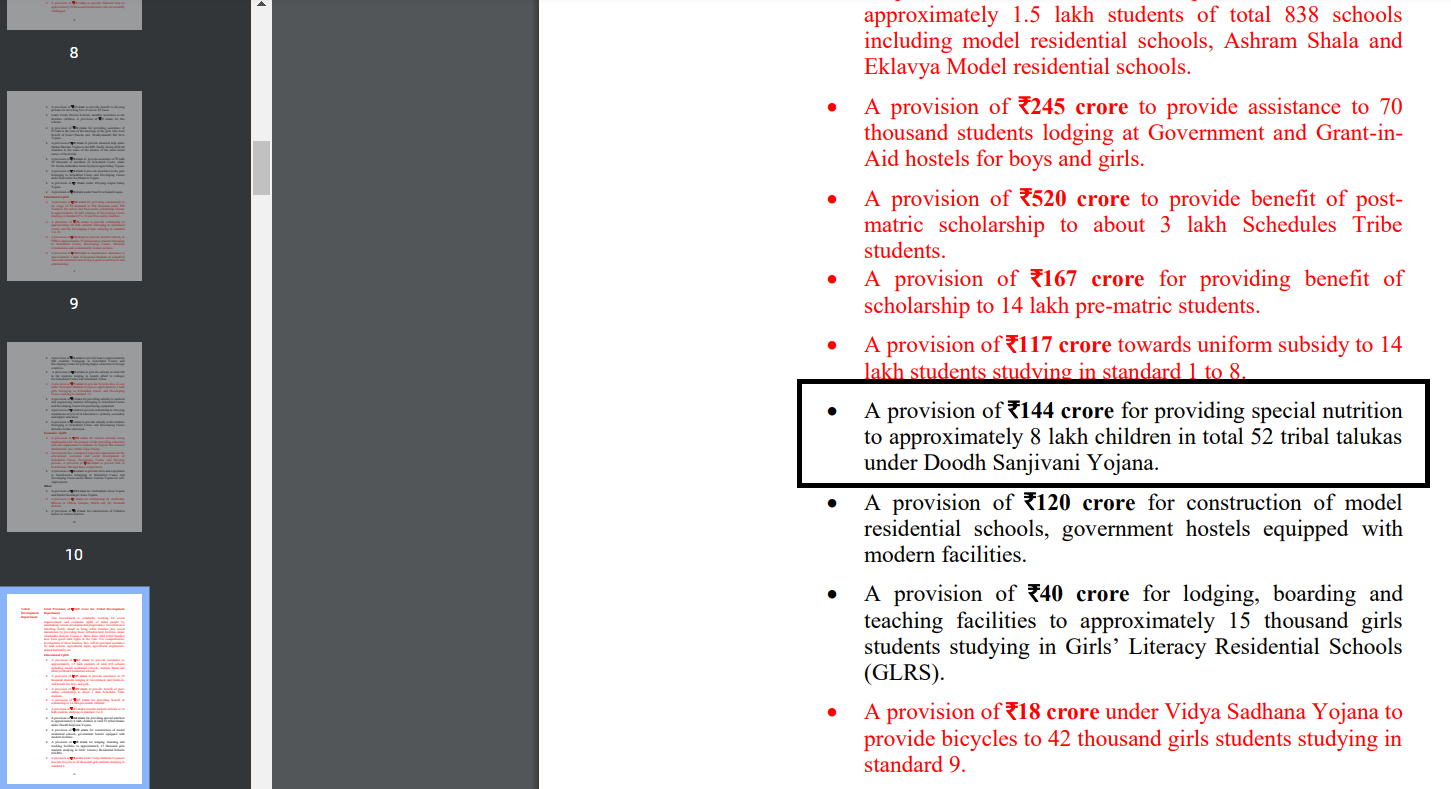
This scheme has successfully solved the problem of malnutrition in children. In the year 2019-20, a total of 7,68,465 children from 8958 schools of 52 talukas of 14 districts were given benefits under this scheme.
Highlights of Doodh Sanjeevani Yojana
| Detail | Information |
|---|---|
| Scheme Name | Doodh Sanjeevani Yojana |
| Launched By | Gujarat government (first implemented in 2006-07) |
| Beneficiaries | Tribal students, children, pregnant women and lactating mothers |
| Benefit | 200 ml fortified flavoured milk daily |
| Coverage | All tribal ICDS blocks across Gujarat |
| Official Website | tribal.gujarat.gov.in |
How the Scheme Is Being Implemented
To make sure the scheme runs well, all scheme processes are being digitised. Procurement is carried out through the GeM portal, financial assistance is given through the Direct Benefit Transfer (DBT) system, and social audits and third-party verification are conducted periodically. These steps help make sure the benefits reach the intended beneficiaries.
For other nutrition support, eligible families can also check the Gujarat Suposhit Mata Swasth Bal Yojana for pregnant women and lactating mothers.
For more details, click the link - https://tribal.gujarat.gov.in/doodh-sanjeevani-yojana
How many Taluka and District included in dudh sanjivni yojna..
for vadodara this scheme is valid or not pls
Dear Savitri Ben, I am Armin Parekh from Mumbai. I teach spoken English.
I would like to teach spoken English to all of the people in your institute and your taluja.
I will relocate to Godhar. I am a Gujrati.
My phone number is 9818269405
My expectations: just 5,000 per month with simple food and stay.