

 AI Summary
Central government is accepting Agriculture Infrastructure Fund Scheme registration and login at the official agriinfra.dac.gov.in portal. Agriculture Infrastructure Fund (AIF) is a central sector financing facility launched by PM Narendra Modi on 9 August 2020 with a total corpus of Rs 1 lakh crore under the Aatmanirbhar Bharat Abhiyan. The scheme gives a loan of up to Rs 2 crore with a 3% interest subvention per annum to build post-harvest and community farming infrastructure. In this article, we will tell you about the scheme registration, loan amount, interest subsidy, how to apply, who can register and complete details.
Agriculture Infrastructure Fund is still open for applications and the government expanded the scheme on 28 August 2024 to bring more projects and support measures under its cover. The scheme is now operational through 2032-33. Farmers, cooperatives, FPOs and agri-entrepreneurs can apply online through the single window facility at agriinfra.dac.gov.in.
What is Agriculture Infrastructure Fund Scheme
Agriculture Infrastructure Fund scheme is aimed at helping farmers get better value for their produce. With the fund, farmers can store and sell at higher prices, reduce wastage, and add processing and value addition. A loan of up to Rs 2 crore is provided under the scheme, and the central government bears a 3% interest subvention per annum on the loan amount.
Hon'ble Finance Minister announced the Rs 1 lakh crore Agri Infrastructure Fund on 15 May 2020 for farm-gate infrastructure for farmers. The financing facility is meant for funding agriculture infrastructure projects at farm-gate and aggregation points such as Primary Agricultural Cooperative Societies, Farmers Producer Organizations, agriculture entrepreneurs and start-ups. The aim is to build affordable and financially viable post-harvest management infrastructure.
Department of Agriculture and Farmers Welfare (DAC and FW) has formulated this central sector scheme to mobilize a medium to long term debt financing facility for investment in viable projects relating to post-harvest management infrastructure and community farming assets through incentives and financial support.
Agriculture Infrastructure Fund Scheme Highlights
| Detail | Information |
|---|---|
| Scheme Name | Agriculture Infrastructure Fund (AIF) |
| Launched By | PM Narendra Modi |
| Total Fund | Rs 1 lakh crore |
| Loan Amount | Up to Rs 2 crore |
| Interest Subvention | 3% per annum |
| Loan Tenure | Up to 7 years |
| Beneficiaries | Farmers, FPOs, PACS, cooperatives, agri-entrepreneurs, startups |
| Application Mode | Online |
| Official Website | agriinfra.dac.gov.in |
Expansion of Agriculture Infrastructure Fund Scheme
Union Cabinet, chaired by PM Narendra Modi, approved a big expansion of the Agriculture Infrastructure Fund scheme on 28 August 2024. This expansion made the scheme more attractive and inclusive for the farming community. Below are the main changes made under the expansion.
- Viable farming assets: The scheme now covers infrastructure for viable projects that build community farming assets, helping eligible people improve productivity and sustainability.
- Integrated processing projects: Eligible activities now include integrated primary and secondary processing projects. Standalone secondary projects remain ineligible and stay under Ministry of Food Processing Industries schemes.
- PM KUSUM Component-A convergence: Farmers, farmer groups, FPOs, cooperatives and Panchayats can now use the convergence between Component-A of PM KUSUM and AIF to promote clean energy along with agriculture infrastructure.
- More credit guarantee options: Along with CGTMSE, credit guarantee cover for FPOs is now available through NABSanrakshan Trustee Company Pvt. Ltd.
Credit Guarantee Coverage in Agri Infrastructure Fund Scheme
Credit guarantee coverage is available for eligible borrowers under the Credit Guarantee Fund Trust for Micro and Small Enterprises (CGTMSE) scheme for a loan up to Rs 2 crore. The fee for this coverage is paid by the government. For FPOs, the credit guarantee can be availed from the facility created under the FPO promotion scheme of DACF and through NABSanrakshan.
All loans under this financing facility get an interest subvention of 3% per annum up to a limit of Rs 2 crore. This subvention is available for a maximum period of 7 years. For loans beyond Rs 2 crore, the interest subvention is limited to Rs 2 crore. The extent and percentage of funding to private entrepreneurs out of the total financing facility may be fixed by the National Monitoring Committee.
Objectives of Agriculture Infrastructure Fund Scheme
This financing facility has many objectives for all the people involved in the agriculture ecosystem.
Farmers (including FPOs, PACS, Marketing Cooperative Societies, Multipurpose cooperative societies)
- Improved marketing infrastructure lets farmers sell directly to a larger base of consumers and increase value realization, which improves the overall income of farmers.
- With investments in logistics infrastructure, farmers can sell in the market with reduced post-harvest losses and fewer intermediaries. This makes farmers more independent and improves access to the market.
- With modern packaging and cold storage access, farmers can decide when to sell in the market and improve realization.
- Community farming assets for improved productivity and better use of inputs result in big savings for farmers.
Government
- Government can direct priority sector lending in currently unviable projects by supporting through interest subvention, incentive and credit guarantee. This starts a cycle of innovation and private sector investment in agriculture.
- Due to improvements in post-harvest infrastructure, government can reduce national food wastage and help the agriculture sector become competitive with global levels.
- Central or state government agencies and local bodies can structure viable PPP projects for attracting investment in agriculture infrastructure.
Agri entrepreneurs and startups
- With a dedicated source of funding, entrepreneurs can push for innovation in the agriculture sector by using new technologies including IoT and AI.
- It also connects the players in the ecosystem and improves avenues for collaboration between entrepreneurs and farmers.
Salient Features of Agriculture Infrastructure Fund Loan Scheme
Below are the main features of the Agriculture Infrastructure Fund loan scheme.
- Size of the financing facility is Rs 1 lakh crore.
- Credit guarantee for a loan up to Rs 2 crore.
- Interest subvention of 3% per annum, limited to Rs 2 crore, though the loan amount can be higher.
- Cap on lending rate so that the benefit of interest subsidy reaches the beneficiary and services to farmers remain affordable.
- Project Management Unit provides handholding support for projects including project preparation.
- Multiple lending institutions including commercial banks, cooperative banks, NCDC, NBFCs and more.
- Online single window facility in collaboration with participating lending institutions.
- Convergence with all schemes of central or state government.
- Moratorium for repayment may vary subject to a minimum of 6 months and a maximum of 2 years.
- Need based refinance support is made available by NABARD to all eligible lending entities including cooperative banks and RRBs as per its policy.
Who can Apply for Agriculture Infrastructure Fund Scheme
Many types of farmers and agriculture groups can apply for the Agriculture Infrastructure Fund loan. Below is the list of eligible people.
- Primary Agricultural Credit Societies (PACS).
- Marketing Cooperative Societies.
- Farmer Producers Organizations (FPOs).
- Farmers.
- Self Help Groups (SHGs).
- Joint Liability Groups (JLGs).
- Multipurpose Cooperative Societies.
- Agri-entrepreneurs and startups.
- Central or state agency or local body sponsored Public-Private Partnership projects.
Eligible Projects under Agriculture Infrastructure Fund Scheme
Many types of projects are eligible for funding under the Agriculture Infrastructure Fund. These include community farming assets, hub and spoke model projects, and post-harvest management projects. Below is the list of eligible projects.
- Viable projects for building community farming assets including organic inputs production, bio stimulant production units, and infrastructure for smart and precision agriculture.
- Projects on hub and spoke model for supply chain infrastructure for clusters of crops including export clusters, and PPP projects promoted by central, state or local governments or their agencies.
- Post-harvest management projects like supply chain services including e-marketing platforms, warehouses, silos, packaging units, assaying units, sorting and grading units, cold stores and cold chain, logistics facilities, primary processing centers, ripening chambers and waxing plants.
Crop-wise eligible PHM and Primary Processing Activities
| Crops | Eligible PHM and Primary Processing Activities | Not eligible under AIF |
|---|---|---|
| Cereals (Wheat, Paddy, etc.) | Cleaning, de-stoning, sorting and grading, hulling, milling, pounding, grinding, tempering, parboiling, soaking, drying, sieving, irradiation | Fermentation, baking, puffing, flaking, frying, extrusion, blending, roasting |
| Fruits and vegetables | Washing, cleaning, drying, sorting, grading, blanching for primary processing, cooling, waxing, conditioning | Dehydration, concentrated products, canning, juice extraction, sterilization |
| Oilseeds | Cleaning, de-stoning, de-husking (decorticating machines), winnowing, oil extraction (ghani, hydraulic press etc.) | By-product utilization, refining, neutralization, bleaching |
| Pulses | Cleaning, de-stoning, drying, sorting and grading, de-husking, splitting, de-hulling, milling, irradiation | Canning, besan, papads, pulse based foods, puffed chickpea, pulse polishing |
| Cotton | Cleaning, drying, ginning, pressing and bailing, lintering | Fibre finishing, scouring, purifying, spinning, weaving |
| Sugarcane | Cane unloading, cleaning, cane breaking, cane milling, straining, evaporators, centrifugation, storage tanks, dryers | |
| Spices | Cleaning, drying, sorting, boiling, polishing, grinding, packaging, storage, irradiation | Roasting, sterilizing, thermal treatment |
| Cocoa | Cleaning, gathering of pods, sorting, breaking of pods, fermentation of cocoa, drying, storage | Roasting, winnowing, alkalization |
| Coffee | Cleaning, drying of cherries, washing, hulling, pulping | Roasting, grinding, extraction |
| Jute | Cutting, retting, stripping, washing, drying, bailing, packing, storage | |
| Cashew | Cleaning, streaming in boiler, shell cutting, drying, peeling, grading, packaging | |
| Moringa | Washing, drying, milling, storage, packaging | |
| Tea | Cleaning, withering, rolling, fermentation, drying, sorting | |
| Rubber | Mastication, mixing, shaping, curing, irradiation | |
| Herbal and Medicinal Crops | Cleaning, sorting, drying | Syrup, pills, cream, roasting, frying, distillation, concentration |
Agriculture Infrastructure Fund - State Wise Allocation
Tentative state and UT wise allocation of Agriculture Infrastructure Fund is given below.
| State/UT | Tentative Fund Allocation (Rs. Cr) |
|---|---|
| Uttar Pradesh | 12831 |
| Rajasthan | 9015 |
| Maharashtra | 8460 |
| Madhya Pradesh | 7440 |
| Gujarat | 7282 |
| West Bengal | 7260 |
| Andhra Pradesh | 6540 |
| Tamil Nadu | 5990 |
| Punjab | 4713 |
| Karnataka | 4525 |
| Bihar | 3980 |
| Haryana | 3900 |
| Telangana | 3075 |
| Kerala | 2520 |
| Odisha | 2500 |
| Assam | 2050 |
| Chhattisgarh | 1990 |
| Jharkhand | 1445 |
| Himachal Pradesh | 925 |
| Jammu and Kashmir and Ladakh | 900 |
| Uttarakhand | 785 |
| Tripura | 360 |
| Arunachal Pradesh | 290 |
| Nagaland | 230 |
| Manipur | 200 |
| Mizoram | 196 |
| Meghalaya | 190 |
| Goa | 110 |
| Delhi | 102 |
| Sikkim | 56 |
| Puducherry | 48 |
| A and N Islands | 40 |
| Daman and Diu | 22 |
| Lakshadweep | 11 |
| Dadra and Nagar Haveli | 10 |
| Chandigarh | 9 |
| Total | 1,00,000 |
Eligible Lending Institutions for Loan under AIF Scheme
After signing a Memorandum of Understanding (MoU) with National Bank for Agriculture and Rural Development (NABARD) or DACF, all the following eligible lending institutions can participate to provide this financing facility.
- All scheduled commercial banks.
- Scheduled cooperative banks.
- Regional Rural Banks (RRBs).
- Small finance banks.
- Non-Banking Financial Companies (NBFCs).
- National Cooperative Development Corporation (NCDC).
- DCCBs with PACS affiliation.
Eligible people can also apply directly for the financing facility under this scheme. There is no requirement of prior scrutiny at any level. Such applications may be considered by the banks at their level. Timely MIS for such applications is made available by the respective banks to DLMC (District Level Monitoring Committee) and SLMC (State Level Monitoring Committee).
Scheme Monitoring
National, state and district level monitoring committees make sure there is real-time monitoring and effective feedback about the implementation of the scheme.
National Level Monitoring Committees
- National level Monitoring Committee (NLMC) guides and steers the implementation of the project and approves the guidelines for implementation.
- National level Implementation Committee (NLIC) examines and recommends the guidelines for implementation and reviews the implementation as per the approved guidelines.
State Level Monitoring Committees
- State level Monitoring Committee (SLMC) implements the guidelines at the state level and provides feedback.
- It guides and steers the implementation of the scheme in the state.
- It examines and approves the selected list of beneficiaries and projects for inclusion in the scheme in consultation with DLMC.
- It sets the targets as per the OOMF format and reviews the progress regularly.
District Level Monitoring Committees
- District level Monitoring Committee (DLMC) is the first line of implementation and monitoring within the overall framework.
- It identifies beneficiaries, makes sure the project is viable and prepares viable project reports to support the beneficiaries in collaboration with PMU.
- It examines the proposal and recommends it to SLMC for consideration.
- DLMC sets targets in consultation with SLMC as per the OOMF format and monitors the progress with the support of PMU.
- DLMC maintains the dashboard in collaboration with PMU.
- It is responsible for the smooth implementation of the scheme and resolves any issues at the district level with the support of the district administration.
Project Management Units
- Farmers Welfare Programme Implementation Society under DACF provides PMU support to the scheme at the central level and state PMUs of PM KISAN at the state level.
- Services of knowledge partners are engaged to identify clusters including export clusters and gaps in supply chains to target projects and prepare viable project reports.
- PMUs provide handholding support for implementation of the scheme and monitor the progress with the support of DLMC.
- PMU maintains the dashboard in collaboration with DLMC.
Output Outcome Monitory Framework
| Outcome statement | Outcome Indicators |
|---|---|
| Improvement in resource provision for agriculture infrastructure | Percentage of fund used for completed projects. Additional investments leveraged due to agriculture infrastructure fund interventions (Rs. Crore) |
| Enhancement in agriculture infrastructure capacity | Total capacity addition in agriculture sector due to infrastructure activities funded (MT). Reduction in post-harvest losses and food wastages (%) |
| Promoting creation and modernization of agriculture infrastructure | No. of projects submitted by eligible entities. Disbursement of funds for eligible projects and investments (Rs. Crores) |
| Increase in amount of interest subvention and credit guarantee support provided | Amount outgo on account of interest subvention (Rs. Crore) No. of projects receiving interest subvention Percent projects receiving interest subvention (of the total projects offered loan under the scheme) Amount outgo on credit guarantee coverage (Rs. Crore) Average percent credit guarantee coverage of the total credit extension under the scheme. |
How to Apply for Loan Under Agriculture Infrastructure Fund Scheme
Farmers and the entities listed above can avail a loan of up to Rs 2 crore from nationalized banks, commercial banks or any other financial institutions empanelled by the government for the scheme. The online registration process is simple and is done through the official portal.
Agriculture Infrastructure Fund Scheme Online Registration and Login for Beneficiaries
Here is the complete process to make beneficiary registration for Agriculture Infrastructure Fund Scheme.
STEP 1 - Visit the official website at https://agriinfra.dac.gov.in/
STEP 2 - On the homepage, go to the "Beneficiary Corner" section and click at the "Register Now" or "Beneficiary Registration" link, or directly open the registration page at https://agriinfra.dac.gov.in/Home/Registration
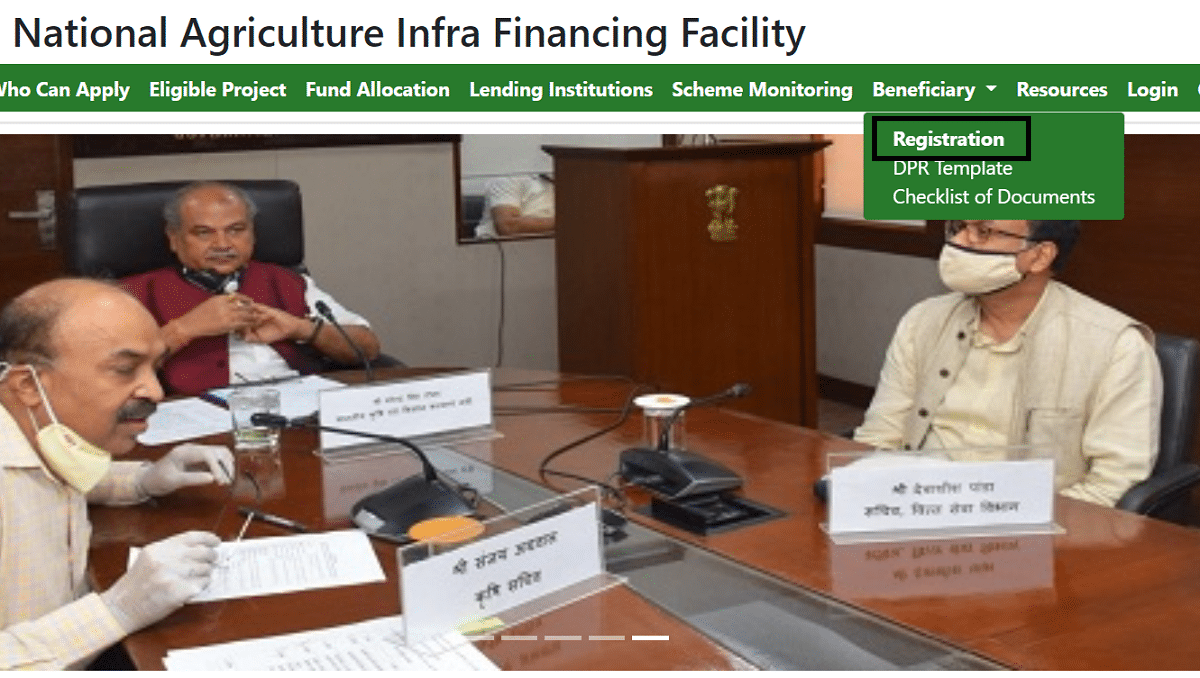
STEP 3 - The Agriculture Infrastructure Fund Scheme online registration form for beneficiaries will appear as shown below.
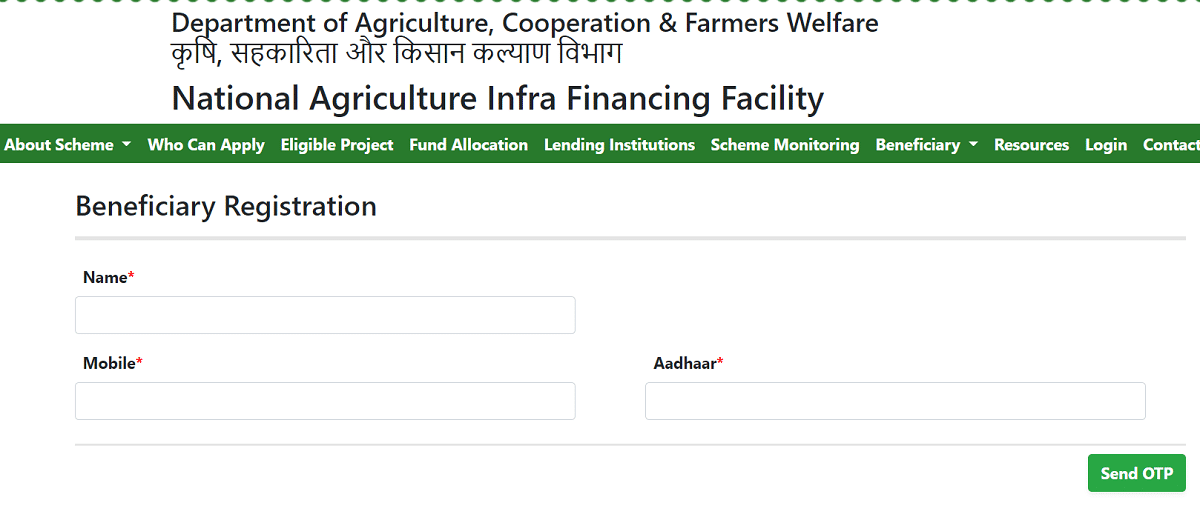
STEP 4 - Here enter the name, mobile number and Aadhaar number of the beneficiary and hit the "Send OTP" button. Verify the OTP to open the complete Agriculture Infrastructure Fund online application form.

STEP 5 - After registration, applicants can log in on the official portal using their email ID or beneficiary ID and password. The login page appears as shown below.
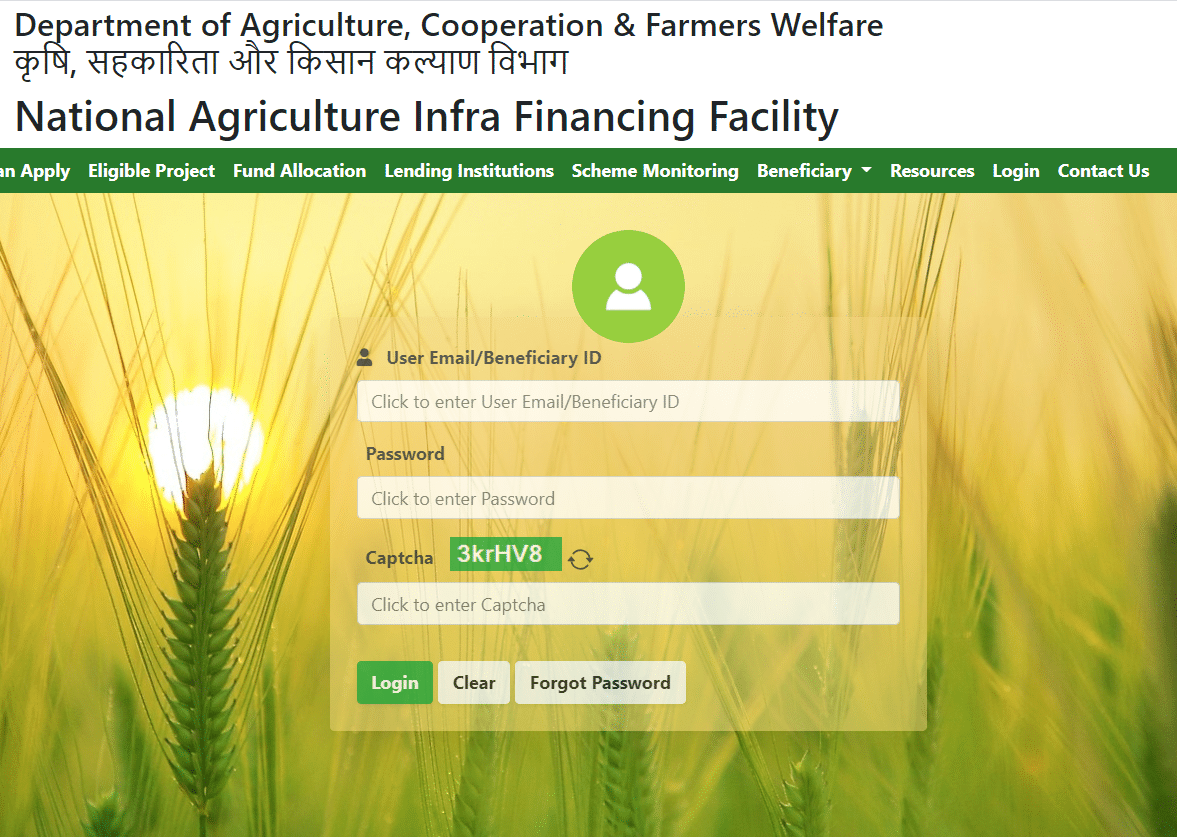
STEP 6 - After login, complete the Agriculture Infrastructure Fund Scheme online application process and submit the required documents for the loan.
Need for National Agriculture Infra Financing Facility
The role of infrastructure is very important for agriculture development and for taking the production dynamics to the next level. It is only through the development of infrastructure, especially at the post-harvest stage, that the produce can be optimally used with opportunity for value addition and a fair deal for farmers. Development of such infrastructure also addresses the vagaries of nature, regional disparities, development of human resource and realization of the full potential of the limited land resource.
Agriculture Infrastructure Fund - Guidelines
The complete guidelines of the Agriculture Infrastructure Fund Scheme can be downloaded in PDF format from the official website of Ministry of Agriculture and Farmers Welfare using the below given link.
Agriculture Infrastructure Fund Scheme Guidelines PDF
Implementation Period of AIF Scheme
The scheme is operational from 2020-21 and has been extended through 2032-33. The financing facility is being distributed through banks and financial institutions. Moratorium for repayment under this financing facility may vary subject to a minimum of 6 months and a maximum of 2 years.
Agriculture Infrastructure Fund Loan Benefits
There are always some benefits of availing a loan under any government scheme, and that is why there are loan schemes by the government. Below are some of the main benefits provided under the Agriculture Infrastructure Fund loan scheme.
- The maximum loan tenure under the scheme is 7 years.
- Interest subvention of 3% per annum on the loan availed under this scheme.
- Credit guarantee coverage under CGTMSE scheme for loans up to Rs 2 crore.
- The fee for this coverage is paid by the government. For FPOs, the credit guarantee can be availed from the facility created under the FPO promotion scheme of DACF and through NABSanrakshan.
Agriculture Infrastructure Fund Loan Scheme supports farmers, PACS, FPOs, agri-entrepreneurs and others in building community farming assets and post-harvest agriculture infrastructure.
FAQ's
How to apply for Agriculture Infrastructure Fund loan
Any eligible farmer or entity can apply for the AIF loan through the banks and financial institutions empanelled by the government, or through the online portal at agriinfra.dac.gov.in.
What is the loan amount under AIF loan scheme
Up to Rs 2 crore.
What is the Interest Subsidy on Loan
3% per annum.
Who can apply for Agriculture Infrastructure Fund loan
Farmers, Primary Agriculture Credit Societies (PACS), Marketing Cooperative Societies, Self Help Groups (SHGs), Farmer Producer Organizations (FPOs), Joint Liability Groups (JLGs), Multipurpose Cooperative Societies, agri-entrepreneurs, agriculture startups and PPP agriculture projects sponsored by central or state agency or urban local body can apply for this scheme.
What is the maximum loan tenure under AIF scheme
7 years.
For more details, please read other frequently asked questions at https://agriinfra.dac.gov.in/Home/FAQs
I HAVE TO APPLY FOR WHEREHOUSE, ON INDIVIDUAL BASIS, HOW TO APPLY , PLEASE SEND APPLICATION FORM
You can visit your nearest bank to avail benefits of Agricultural Infrastructure Fund.
Banker not entertain individual...for Agri infrastructure fund scheme...I have collateral also but they ignore....coz they don't bother....
I have contacted the bank,
For construction of godown given application.they are expressing, they have forwarded application to head office, we are not giving any assurances regarding above scheme of central/state govt
tried several times couldn,nt applay OTP
Very good concept for INDIAN farmers
I'm also interested to build cold storage go down how to access any have idea than do share with me.
CAN WE APLY GOT FORMING LOAN UNDER THIS SCHEAM
I need this programm to be among
How can a small scale farmer apply for this scheme and can a company apply by the name and land of the farmer?
I'm very appreciated
in how many days, the amount will be received by the entrepreneur after applying