
National Education Policy (NEP) 2020 is the current education policy of India, approved by the Union Cabinet on 29 July 2020. It replaces the 1986 policy and brings a new 5+3+3+4 structure with 12 years of schooling and 3 years of Anganwadi or pre-schooling. The policy is being rolled out across the country, and the Ministry of Education has made the full NEP 2020 PDF available for download online.
The Central government approved NEP 2020 to bring very helpful reforms in school and higher education. The policy aims for universalization of education from pre-school to secondary level with 100% gross enrolment ratio (GER) in school education by 2030. It also aims to bring 2 crore out of school children back into the mainstream. A new 5+3+3+4 curriculum with 12 years of schooling and 3 years of Anganwadi or pre-schooling has been introduced.
NEP 2020 focuses on foundational literacy and numeracy, with no rigid separation between academic streams, extracurricular activities and vocational streams in schools. Vocational education will start from Class 6 with internships. Teaching up to at least Grade 5 will be in the mother tongue or local language. Assessment reforms include a 360 degree Holistic Progress Card to track student learning for achieving learning outcomes. GER in higher education is to be raised to 50% by 2035, with 3.5 crore seats to be added.
Higher education curriculum will have flexibility of subjects, and multiple entry and exit will be allowed with certification. Academic Bank of Credits has been set up to help transfer of credits. National Research Foundation has been established to encourage a strong research culture. Regulation of higher education will be light but tight, with a single regulator and four separate verticals for different functions.
National Education Policy (NEP) 2020 PDF Download Online
The full NEP 2020 document is available for download from the official Ministry of Education website. The final policy PDF can be downloaded in English from the links below. The policy was built on the basis of the Draft National Education Policy 2019, which was released in May 2019.
NEP 2020 Final PDF - English (Ministry of Education)
NEP 2020 Final PDF - English (UGC)
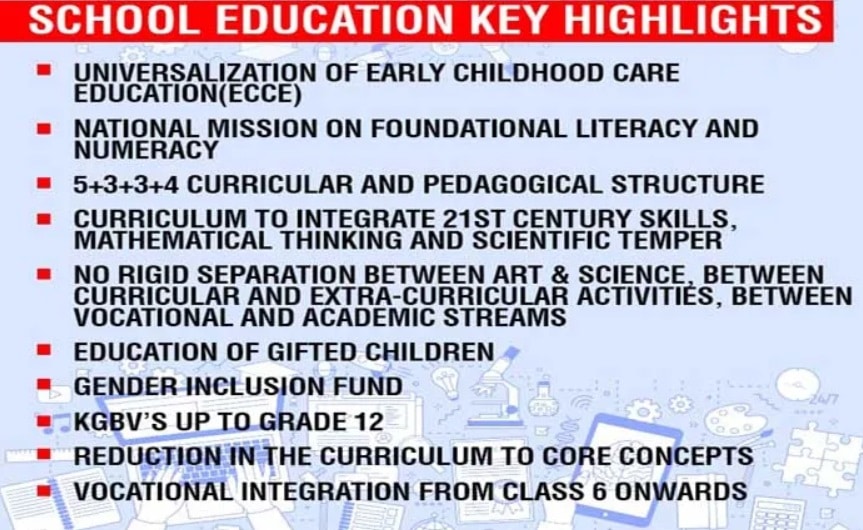
NEP 2020 for School Education - Key Highlights
From school education to higher education, NEP 2020 provides a new structure to the education sector of the country. The important features and highlights of NEP 2020 for school education are as follows:
- New 5+3+3+4 structure: The existing 10+2 structure is modified to a 5+3+3+4 structure covering ages 3 to 18 years. The foundational stage covers 3 years of pre-school learning and Grades 1 and 2, the preparatory stage covers Grades 3 to 5, the middle stage covers Grades 6 to 8, and the secondary stage covers Grades 9 to 12.
- Early Childhood Care and Education (ECCE): Emphasis is given to ECCE for ages 3 to 6, with provisions to make sure universal access to high quality ECCE across the country in a phased manner.
- Foundational literacy and numeracy: A National Mission on Foundational Literacy and Numeracy is set up to focus on foundational literacy. All state and union territory governments will prepare an implementation plan to achieve universal foundational literacy and numeracy in all primary schools by Grade 3, with a target of 2026-27.
- Flexibility in subjects: Students get more freedom and choice of subjects, particularly in secondary school, including in physical education, arts and crafts, and vocational skills. Coding can begin from Class 6.
- Mother tongue teaching: Medium of instruction till Grade 5 is the mother tongue, home language or local language. Three languages are taught to all students, and states decide which ones.
- Use of technology: E-content in regional languages is developed, and schools are to be digitally equipped. National Educational Technology Forum (NETF) is formed.
- Examination reforms: Key stage assessments at Grades 3, 5 and 8 are conducted to track the development of the child. Board examinations are reformed, with students tested on core capabilities.
NEP 2020 also proposes a considerable change in the examination structure. Key stage assessments at Grades 3, 5 and 8 are conducted to track the development of the child. Board examinations are made easier, with students tested on core capabilities. A more modular model is expected to be explored instead of just one board.
NEP 2020 for Higher Education - Key Highlights
Here are the important features and highlights of NEP 2020 for higher education:
- Single regulator: UGC and AICTE are replaced by a single higher education regulator, the Higher Education Commission of India (HECI). HECI has four verticals for regulation, accreditation, funding and academic standard setting.
- Multidisciplinary education: Impetus is given to multidisciplinary education. Even IITs move towards a more complete curriculum with arts and humanities.
- Flexible degree: The undergraduate degree can be of either 3 or 4 year duration, with multiple exit options. A certificate after 1 year, a diploma after 2 years, and a Bachelor's degree after 3 years. The 4 year multidisciplinary Bachelor's programme is the preferred option.
- National Research Foundation: NRF is set up to enable a culture of research, funding competitive peer reviewed grant proposals across all disciplines.
- Academic Bank of Credits: ABC is set up to help flexible credit transfers and multiple entry and exit options for students.
Major reforms in higher education give more flexibility to students. Students can choose any set of subjects for higher education and take other options. For students looking for skill and apprenticeship support, the SHREYAS scheme provides higher education and apprenticeship support.
| Detail | Information |
|---|---|
| Scheme Name | National Education Policy (NEP) 2020 |
| Approved By | Union Cabinet on 29 July 2020 |
| Implemented By | Ministry of Education |
| School Structure | 5+3+3+4 with 12 years of schooling and 3 years of pre-schooling |
| School GER Target | 100% by 2030 |
| Higher Education GER Target | 50% by 2035 |
| Official Website | education.gov.in |
NEP 2020 Implementation Progress
NEP 2020 is being implemented across the country. NITI Aayog released its first complete review of the policy in October 2025, checking progress across all states and union territories. The report notes that the Academic Bank of Credits has been integrated for 2.36 crore students, and the DIKSHA platform has recorded over 4.93 billion sessions. Under the NIPUN Bharat Mission, foundational literacy and numeracy is being targeted for every child by Grade 3 by 2026-27.
Over 14,500 schools have been transformed into PM SHRI models with solar panels, nutrition gardens and Atal Tinkering Labs. The ULLAS scheme has enrolled over 20 million learners. All higher education institutions are to become multidisciplinary by 2040, with 35 flagship MERU institutions receiving ₹100 crore each for autonomy and global ties.
NEP Draft was presented in 2019, where it received both appreciation and strong criticism. The suggestion of making Hindi one of the required languages was soon shot down by many. The draft was then put in public domain and suggestions invited from people and all stakeholders. The Ministry of Education received lakhs of suggestions, and the NEP draft was modified as per this.
FAQ's
Is NEP 2020 still the current education policy?
Yes, NEP 2020 is the current national education policy of India and is being implemented across the country.
Where can I download the NEP 2020 PDF?
The full NEP 2020 PDF can be downloaded from the official Ministry of Education website at education.gov.in.
Definitely it's a good decision students got weak and lazy they don't have a time to play food etc due to excess load of school homework 4 o'clock they reach home when they study or when they play. There is no time of relaxation. Mhrd keep it up, I support you and hope you will take good decision in future
1. It is seen that there will be two kinds of bachelor degrees: one with 3 yr duration and the other with 4 yr duration. What will be the nomenclature of degrees with two different duration? Pass and Honours(Major)?
2. Three languages at the Preparatory Stage (PS) ,classes 3 to 5, is a burden on children (aged 8 to 11).Can the Government provide teachers for 3 languages at this PS (elementary school level) in all schools in India? From psychological point of view this proposal is unsound.There could be one or two languages.
3. Good to know that Grades 9 to 12 would be considered under one stage, i.e. Secondary State.But a public examination at the end of this stage could be prescribed to determine entry to any of the diverse post- school tertiary level courses.
4.Flexibility in choice of subjects is welcome. Encouragement in research and innovation is welcome. Master Degrees could be of two types M.A./M.Sc.( By Research) and M.A./M.Sc.( By course).
5. Proper course design and adequate number of teachers to guide the students in each area of study and research are must.
6.Restoration of globally recognised nomenclature 'Education Ministry' by termination of ' Ministry of Human Resource Development' is welcome.
In the above mentioned education policy, there is no describe in the subject of COMMERCE , while commerce is big subjects to the nation or international trade, I request to the education ministry clear the views.
1. It would be a successful implementation only if all Teachers and Principals working at the ground level are been compulsorily trained and the idea is been communicated to them properly.
2. Technology - CS/IT should be the part of the main subjects in all classes and made compulsory, especially in the rural India.
3. The Policy doesn't mention clearly about the Medical Education, students who intend to go in the field of medicine should be given fair chance and training in school education, this will motivate the students in the rural area to take up medicine, unlike the current system, where students unable to take up coaching classes are unable to crack entrance.
4.Entrance should be a cumulative test of the past knowledge, unlike the current JEE/NEET which has advanced curriculum referring to different books ,authors/ publishers and uncertainty. Giving a fair chance to rural and urban students for medical education should be the aim of the education system.
5. This is the first time any government has thought so much in depth of the education system, so the medical education system needs to be worked on from the increase in the number of colleges till the selection system.
6. Inclusive education today has no specific guidelines as far as the academic curriculum is concerned. It would be highly appreciated if a proper curriculum be chalked out by a panel of special educators and counselors for children with different disabilities. Guidelines regarding training such students so that they a part of the main stream education and it is not taxing to both the teacher, students and parents.
Mrs Jayashree Hebbare, your suggestions are quite useful, we will forward it to the concerned Ministry of Education.
please send me नई राष्ट्रीय शिक्षा नीति 2020 PDF in hindi / marathi immediately
Download Link is already given above in the article...
Thanks
प्रति,
मा. पंतप्रधान, भारत सरकार, नवी दिल्ली (vide PMOPG/E/2020/0697227)
विषय—शैक्षणिक धोरण-२०२०
नविन शैक्षणिक धोरणामध्ये थोर विचारवंतांच्या विचारांना स्थान आहे का ? ? ? याचा खुलासा करावा हि नम्र विनंती.
१. राष्ट्रपिता महात्मा गांधी म्हणतात,----शिक्षण म्हणजे काय ? जर त्याचा अर्थ अक्षरज्ञान एव्हढाच असेल तर ते एक साधनच झाले. त्याचा सदुपयोगही होईल आणि दुरूपयोगही होईल. ज्या ह्त्याराने शस्त्रक्रिया करून आजाऱ्याला बरे करता येते, तेच ह्त्यार जीव घेण्यासाठीही वापरता येते. तसे अक्षरज्ञानाचे आहे. त्याचा दुरूपयोग पुष्कळ माणसे करतात हे तर आपण पाहतोच. त्याचा सदुपयोग त्या मानाने थोडीच माणसे करतात. हे माझे म्हणणे बरोबर असेल तर अक्षरज्ञानाने जगाला फायदा होण्याएवजी त्याचे नुकसान झाले आहे असे सिध्द होते. शिक्षणाला शुध्द चारित्र्याची बैठक नसेल तर त्या शिक्षणाची किंमत शून्य आहे. त्या शिक्षणाला सत्यनिष्ठेचा व शुध्दतेचा भरभक्कम आधार नसेल तर ते कुचकामी ठरेल. आपल्या जीवनातील व्यक्तीगत शुध्दता, पावित्र्य यांकडे शिक्षकांचे लक्ष नसेल तर शिक्षकांचा नाश होईल. शिक्षकांच्या पांडित्याला काहीही किंमत नाही.
२. माजी राष्ट्रपती डॉ. राधाकृष्णन् म्हणतात,----आपण पक्ष्याप्रमाणे विहार करण्यास शिकलो, माशाप्रमाणे पाण्यात तरंगण्यास शिकलो, परंतू माणसाप्रमाणे वागण्यास शिकलो नाही. शिक्षक आणि विद्यार्थ्यांमध्ये घट्ट जिव्हाळ्याचे संबंध असले पाहिजेत. त्यांना विद्यार्थ्यांबद्दल ममता वाटली पाहिजे आणि विद्यार्थ्यांचा आदर त्यांनी सहजतेने संपादन केला पाहिजे.
३. माजी राष्ट्रपती डॉ. कलाम यांनी विद्यार्थ्यांना दिलेल्या ७ शपथा आणि शिक्षकांना दिलेल्या १० शपथा यांचा विचार.
४. शिक्षकांचे व पालकांचे प्रबोधन करणे अत्यावश्यक आहे.
५. शारिरीक विकास, मानसिक विकास, बौध्दीक विकास, आध्यात्मिक विकास या सर्वांगिण व्यक्तिमत्त्व विकासाचा समावेश आहे का ?
या सर्व कार्यासाठी, उपक्रमासाठी प्रामाणिक, कार्यक्षम व हुषार व्यक्तींची च नेमणूक केली पाहिजे.
This Education policy is waiting for implimentation and result. It seems hopefull and Quality based with National vision.
Yes, definitely, lets all hope that it changes something for the good.
ONE NATION
ONE EDUCATION
LEARN VOCATION
WILL EXCEL IN PROFESSION
for junior kids its good because they will learn more by doing activities as well as they will have knowledge about the skills and will have curiosity to know about the things such as: what, why, how etc.
thanks for giving awesome information on new education policy you cover all important topic,
I'M following your blog from last few year and there are amazing information all of your article keep doing your work
पहले भी 3-6 साल का बालक आँगनबाडी में जा रहा है | पहली दूसरी में खेल खेल में शिक्षा प्रदान की जारी है | सरकारी विद्यालयों में आठवीं तक बच्चे अपनी भाषा /राजभाषा में शिक्षा ग्रहण कर रहे है | इसके बाद की शिक्षा दसवीं तक हिन्दी में ही पढ़ रहे है | 1986 से पूर्व उच्चतर माध्यमिक विद्यालयों में सके का चयन नौवीं कक्षा में हो जाता था | इस प्रकार यदि देखें तो थोड़े से बदलाव के बाद सारे का सारा ढांचा उसी प्रकार लग रहा है आम नागरिक के बच्चों को इससे कोई अंतर नहीं पड़ने वाला |
इस शिक्षा नीति में सामाजिक भेदभाव बढेगा ही घटने का प्रश्न उत्पन्न नहीं होता | पाठ्यक्रम भले ही सब के लिए सामान हो पर प्रश्न भाषा का है | कुछ फिर भी अंतर्राष्ट्रीय भाषा अंगरेजी में शिक्षा प्राप्त करते रहेंगे और सरकारी व कुछ अन्य विद्यालय अपनी मात्री भाषाओं में शिक्षा प्राप्त करते रहेंगे | सिया प्रकार दोनों में समाजिक स्तर पर अंतर बना रहेगा | यदि रोजगार के अवसर उसके बाद भी आंगल भाषा वालों के लिए अधिक रहेंगे वे देश और विदेश दोनों में रोजगार के अवसर प्राप्त कर सकेंगे और मातृभाषा की शिक्षा केवल ज्ञान हासिल करने तक ही सीमित रह जाएगी |
I AM REQUESTING TO GOVERMENT PLEASE LEARN CODING NOT ONLY AGE OF 6-14 YEAR KID. PLEASE LEARN CODING IN AGE OF 6-18.
Your Information Help Me a LOt Thank You..
Mrs. Jayashree Hebbare, your suggestions are quite useful, we will forward it to the concerned Ministry of Education.
Hi Can you provide the latest MHRD New National Education Policy or is this the latest one?
Thanks
Thanks for this.
Hope this will work great
In the above mentioned education policy, there is no describe in the subject of COMMERCE , while commerce is big subjects to the nation or international trade, I request to the education ministry clear the views.
Very Nice Information. It Helps a Lot
Nice Information Please Provide More Post Like This
why the full content is only in Hindi Please inform where the pure English version is available