
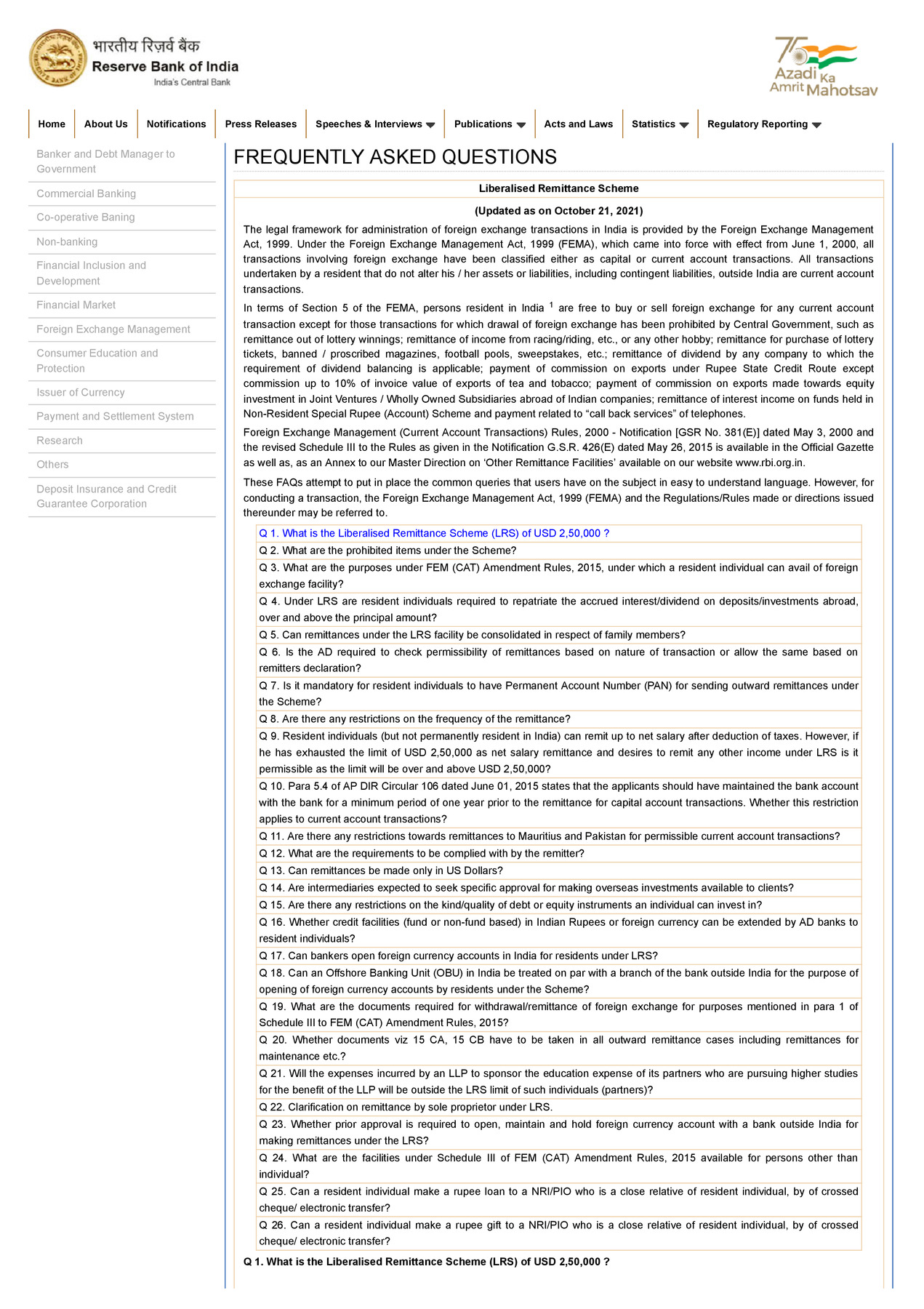
RBI Liberalised Remittance Scheme (LRS) 2026 allows every resident individual, including minors, to remit up to USD 2,50,000 per financial year (April to March) for any permissible current or capital account transaction or a combination of both. Reserve Bank of India keeps updating the scheme rules, and the latest changes for 2026 are explained below.
Resident individuals can also get foreign exchange facility for the purposes mentioned in Para 1 of Schedule III of FEM (CAT) Amendment Rules 2015, dated May 26, 2015, within the limit of USD 2,50,000 only. The scheme is open for the financial year 2026-27 and remittances are processed through Authorised Dealer banks and Full-Fledged Money Changers (FFMCs).
RBI LRS Scheme 2026
RBI LRS Scheme was introduced on February 4, 2004, with a limit of USD 25,000. The LRS limit has been revised in stages consistent with prevailing macro and micro economic conditions. It now stands at USD 2,50,000 per financial year.
In case of remitter being a minor, the LRS declaration form (Form A2) must be countersigned by the minor's natural guardian. The scheme is not available to corporates, partnership firms, HUF, Trusts etc.
For 2026, RBI has changed the reporting process. With effect from January 1, 2026, AD Category-II banks and Full-Fledged Money Changers (FFMCs) have to submit the LRS daily return directly on the Centralised Information Management System (CIMS) portal of RBI. Earlier these returns were routed through AD Category-I banks.
Tax Collected at Source (TCS) rules for LRS remittances have also been simplified from April 1, 2026. A uniform 2% TCS now applies on education, medical treatment and overseas tour package remittances, replacing the earlier tiered rates of 5% to 20%.
| Detail | Information |
|---|---|
| Scheme Name | RBI Liberalised Remittance Scheme (LRS) |
| Launched By | Reserve Bank of India |
| Launch Date | February 4, 2004 |
| Beneficiaries | Resident individuals including minors |
| Remittance Limit | USD 2,50,000 per financial year |
| Application Mode | Through Authorised Dealer banks and FFMCs using Form A2 |
| Official Website | rbi.org.in |
Prohibited Items under LRS Scheme
The remittance facility under the scheme is not available for the following purposes:
- Remittance for any purpose specifically prohibited under Schedule-I (like purchase of lottery tickets/sweep stakes, proscribed magazines, etc.) or any item restricted under Schedule II of Foreign Exchange Management (Current Account Transactions) Rules, 2000.
- Remittance from India for margins or margin calls to overseas exchanges / overseas counterparty.
- Remittances for purchase of FCCBs issued by Indian companies in the overseas secondary market.
- Remittance for trading in foreign exchange abroad.
- Capital account remittances, directly or indirectly, to countries identified by the Financial Action Task Force (FATF) as "non-cooperative countries and territories", from time to time.
- Remittances directly or indirectly to those individuals and entities identified as posing significant risk of committing acts of terrorism as advised separately by the Reserve Bank to the banks.
Documents Required for LRS Remittance
PAN is required for all LRS transactions. The remitter has to designate a branch of an Authorised Dealer bank through which all remittances under the scheme will be made. For capital account remittances, the applicant should have maintained the bank account with the bank for a minimum period of one year prior to the remittance.
Form A2 is the main declaration form for purchase of foreign exchange under LRS. The remitter has to declare the purpose of remittance and confirm that the funds belong to him or her and will not be used for prohibited purposes.
Official Links for LRS Scheme
RBI Master Direction on Liberalised Remittance Scheme is available at RBI Master Direction on LRS. The detailed RBI FAQ on Liberalised Remittance Scheme is also published on the official website rbi.org.in.
FAQ's
What is the LRS limit for 2026-27?
The LRS limit remains USD 2,50,000 per financial year (April to March) for every resident individual. This limit is per person and per financial year.
Who can use the RBI LRS Scheme?
All resident individuals, including minors, can use the scheme. It is not available to corporates, partnership firms, HUF, Trusts etc.
Is PAN required for LRS remittance?
Yes, PAN is required for all transactions under LRS made through Authorised Persons.
Can remittances be made only in US Dollars?
No, remittances can be made in any freely convertible foreign currency.
What is the new CIMS reporting rule from 2026?
From January 1, 2026, AD Category-II banks and FFMCs submit the LRS daily return directly on the CIMS portal of RBI instead of routing it through AD Category-I banks.
RBI has launched several other schemes for citizens. Check RBI Lead Bank Scheme 2026 Guidelines and RBI Retail Direct Scheme 2026 Online Registration for more details. RBI Digital Currency (CBDC) Concept Note is also available on the official website.