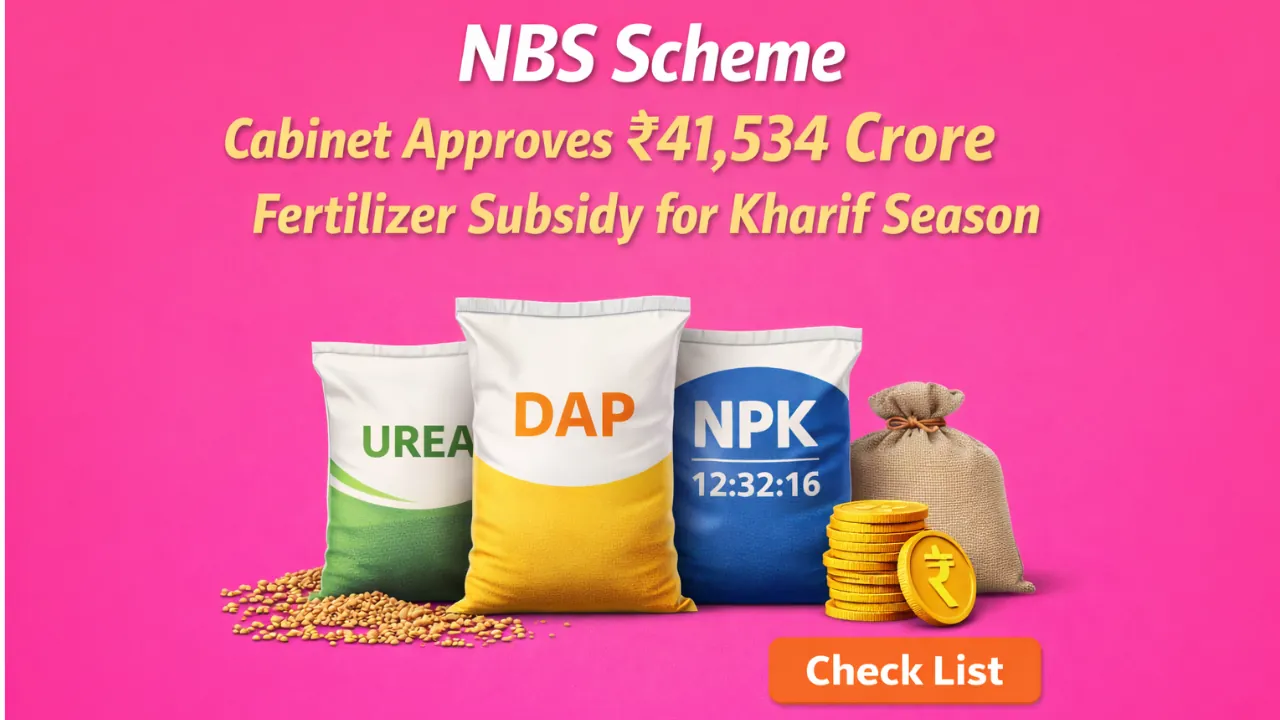
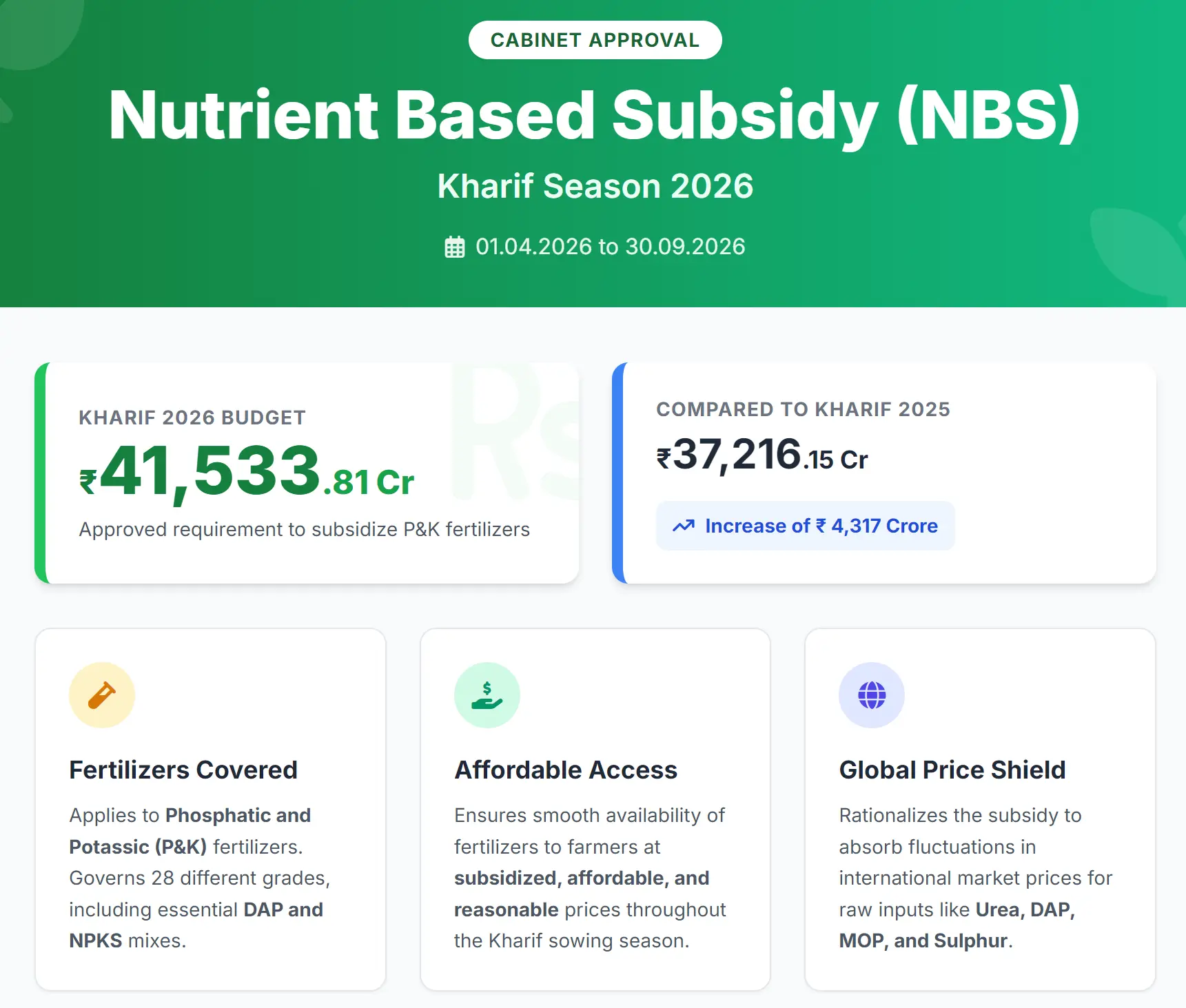
Big news for farmers across India, the union cabinet, chaired by Prime Minister Narendra Modi, has approved a massive ₹41,534 crore fertilizer subsidy under the Nutrient Based Subsidy (NBS) Scheme for the Kharif 2026 season. This subsidy is active from April 1, 2026 to September 30, 2026, and covers 28 grades of Phosphatic and Potassic (P&K) fertilizers including the widely used DAP (Di-ammonium Phosphate).
This approval means farmers will continue to get fertilizers like DAP, MOP (Muriate of Potash), and various NPKS grades at affordable, subsidized prices during the Kharif sowing season. The subsidy amount is about ₹4,317 crore more than what was approved for the Kharif 2025 season, which was ₹37,216.15 crore. That is roughly a 12% jump year over year, showing that the government is committed to keeping fertilizer costs manageable for farmers even as global prices stay unstable.
What is NBS Scheme?
The Nutrient Based Subsidy (NBS) Scheme has been running since April 1, 2010. Under this scheme, the government fixes a per-kg subsidy rate for key nutrients like Nitrogen, Phosphate, Potash, and Sulphur. Fertilizer companies get this subsidy directly from the government, and in return, they are expected to sell fertilizers to farmers at prices that are lower than the actual market cost.
The retail prices of P&K fertilizers like DAP, MOP, and NPK blends are not fully controlled by the government. Manufacturers set their own prices, but the subsidy from the Centre makes sure farmers do not end up paying the full international market rate. This setup has been running for over 16 years and continues to be one of the most important support systems for Indian agriculture.

NBS Kharif 2026 Subsidy Rates Per Kg
For the Kharif 2026 season, the government has revised the nutrient-wise subsidy rates upward for most nutrients. Here is a comparison of the approved rates:
| Nutrient | Kharif 2026 Rate (per kg) | Rabi 2025 Rate (per kg) |
|---|---|---|
| Nitrogen (N) | ₹47.32 | ₹43.02 |
| Phosphate (P) | ₹52.76 | ₹47.96 |
| Potash (K) | ₹2.38 | ₹2.38 (unchanged) |
| Sulphur (S) | ₹3.16 | ₹2.87 |
As you can see, the subsidy rates for Nitrogen, Phosphate, and Sulphur have all gone up. Only the Potash rate has been kept the same as the previous Rabi season. This increase is mainly because international prices of fertilizer raw materials like Urea, DAP, MOP, and Sulphur have been moving up in recent months.
NBS Scheme 2026 Highlights
| Detail | Information |
|---|---|
| Scheme Name | Nutrient Based Subsidy (NBS) Scheme |
| Announced By | Union Cabinet, Government of India |
| Approval Date | April 8, 2026 |
| Applicable Season | Kharif 2026 (April 1 to September 30, 2026) |
| Total Budget | ₹41,533.81 crore |
| Fertilizers Covered | 28 grades of P&K fertilizers including DAP and NPKS |
| Scheme Running Since | April 1, 2010 |
| Increase Over Kharif 2025 | ₹4,317 crore (approx. 12% more) |
| Nodal Department | Department of Fertilizers, Government of India |
| Official Website | fert.gov.in |
Why Was the Subsidy Increased?
The decision to raise the NBS rates for Kharif 2026 is directly tied to what is happening in global fertilizer markets. Prices of key inputs like Urea, DAP, MOP, and Sulphur have seen significant changes in international markets. If the government had kept the subsidy at the same level, fertilizer companies would have had to pass on these higher costs to farmers, making farming more expensive.
By increasing the NBS rates, the government is absorbing a bigger share of these international price fluctuations. This is especially important for Kharif crops, which are sown with the southwest monsoon starting around June. Farmers need access to fertilizers at predictable, affordable prices well before and during the sowing season. The announcement well in advance of the main sowing period gives farmers and fertilizer suppliers enough time to plan.
Who Benefits from NBS Scheme?
Any farmer in India who buys P&K fertilizers including DAP, MOP, or NPK blends benefits from this scheme. The subsidy does not go directly into the farmer's hands. Instead, it is paid to fertilizer manufacturers and importers. These companies, in turn, are required to sell fertilizers at prices below what it would otherwise cost without government support.
Some of the key fertilizers covered under the 28 grades of P&K include:
- DAP (Di-ammonium Phosphate) - One of the most used fertilizers in India, especially at the time of sowing. It provides both Nitrogen and Phosphate in good quantities, making it popular across crops like wheat, paddy, pulses, and oilseeds.
- MOP (Muriate of Potash) - A potassium-rich fertilizer that helps in root development, disease resistance, and overall crop quality. Used widely in sugarcane, potato, cotton, and vegetable crops.
- NPKS grades - These are complex fertilizers that contain Nitrogen, Phosphate, Potash, and Sulphur in different combinations, suited for different soil types and crop needs across the country.
Farmers who use these fertilizers through registered fertilizer retailers in their area automatically benefit from the lower retail prices that this subsidy makes possible. No separate application or registration is required for farmers to get this benefit.
Total Fertilizer Subsidy Budget for FY 2026-27
The overall budgetary allocation for both the NBS Scheme and the Urea Subsidy Scheme for FY 2026-27, which covers Kharif 2026 and Rabi 2026-27, is about ₹1,70,799 crore. This is one of the largest government expenditures in the agriculture sector and shows how seriously the government is treating fertilizer affordability as a policy priority.
The One Nation One Fertilizer Scheme is another related scheme running alongside NBS, under which urea is sold under the unified "Bharat" brand across the country. Together, these two programs form the backbone of India's fertilizer subsidy architecture. Farmers can also check out the PM Kisan Credit Card (KCC) scheme for low-interest loans to meet their farming input costs including fertilizers.
FAQ's
What is the NBS Scheme for Kharif 2026?
NBS stands for Nutrient Based Subsidy. Under this scheme, the government fixes a per-kg subsidy rate for nutrients like Nitrogen, Phosphate, Potash, and Sulphur in P&K fertilizers. For Kharif 2026, a total budget of ₹41,534 crore has been approved, effective from April 1 to September 30, 2026.
Which fertilizers are covered under NBS Scheme?
The scheme covers 28 grades of Phosphatic and Potassic (P&K) fertilizers. This includes popular fertilizers like DAP (Di-ammonium Phosphate), MOP (Muriate of Potash), and various NPKS grades. Urea is handled under a separate subsidy scheme and is not part of NBS.
Do farmers need to apply separately for this subsidy?
No, there is no separate application process for farmers. The subsidy is directly paid to fertilizer manufacturers and importers. Farmers automatically benefit when they buy covered fertilizers from authorized retailers at the subsidized retail price.
What are the NBS rates for Kharif 2026?
For Kharif 2026, the per-kg subsidy rates are: Nitrogen at ₹47.32, Phosphate at ₹52.76, Potash at ₹2.38, and Sulphur at ₹3.16. Rates for Nitrogen, Phosphate, and Sulphur have been increased compared to the Rabi 2025 season.
Why was the NBS subsidy increased for Kharif 2026?
The increase is because of rising international prices of fertilizer inputs like Urea, DAP, MOP, and Sulphur. By raising the subsidy rates, the government is making sure that the higher global costs do not get passed on to Indian farmers.
When did the NBS Scheme start?
The Nutrient Based Subsidy Scheme for P&K fertilizers started on April 1, 2010, and has been running continuously since then. The rates are revised every season (Kharif and Rabi) based on international market conditions.